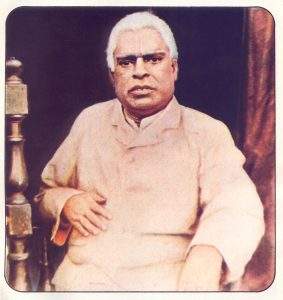
Early Life
Bhaktivinoda Thakura was born on September 2, 1838, in Biranagara, Nadia district. He was the seventh son of Raja Krishnananda Datta, a great follower of Lord Nityananda. He grew up in a family where Vaishnavism was not respected, especially on his mother's side. He was named Kedaranatha after his spiritual father.
His childhood was spent at his maternal uncle's estate, where the environment was very wealthy. He finished primary school, which was led by his grandmother, and later attended an English school in Krishnanagar, led by the King of Nadia, but had to drop out of this school when his brother died of cholera.
Hardships in Youth
His father died when he was only 11 years old. The ownership of his grandmother's lands passed to others, and the family wealth proved to be illusory. The family fell into poverty. Nevertheless, Kedaranatha Datta struggled with difficulties.
When he was only 12 years old, his mother organized his marriage to the 5-year-old daughter of Madhusudana Mitra Mahashaya.
Education and Career
When he was thirteen, his maternal uncle Kashiprasada Ghosh Mahashaya took the boy to Calcutta, where he himself directed the English education system. He enrolled Kedaranatha Datta as a student and, as he was the most famous writer and editor in Calcutta at that time, got his nephew to correct manuscripts submitted for publication. Kedaranatha Datta quickly became an English language expert.
Muslim's Prophecy
However, after falling ill from the salty water of Calcutta, he returned to Ulagrama, where he was treated by a Muslim prophet who predicted that the village of Biranagara would soon turn into a wasteland, while Kedaranatha Datta himself would become a famous devotee of Krishna.
In 1856, KD entered college in Calcutta. He wrote very intensively and at the same time taught practical English skills. He even taught one student who later became a very famous orator in the British Parliament. At that time he was fascinated by Christian theology, which he considered more valuable than Hindu monism.
Career Path
1860 His first son Ananda Prasada (Achyutananda) was born in Bhadraka. In the same year, KD published a book in English about all temples and ashrams in the state of Orissa.
1861 Receives service in the Bengal Government as deputy magistrate. Founded the "Bhratri Samaja" organization and published the book "Our Aspirations".
1866 KD became a quite influential government official and traveled quite a lot. Learned Persian and Urdu languages.
Spiritual Awakening
While being principal of Medinipura High School, he began exploring philosophies and practices of various religious currents. He saw that they were all very cheap. Finally he understood that the only true religion ever established in Bengal was Sri Chaitanya Mahaprabhu's movement, but unfortunately it was very poorly presented.
Discovery of Chaitanya Charitamrita
In 1868, while traveling from state to state and changing services and rising on the career ladder, he obtained copies of CC and SB from Calcutta. He read these books again and again.
He immersed himself in KC literature and read it day and night. He constantly prayed for Krishna's mercy and understood the supremacy of Krishna as the Supreme Personality of Godhead over all creation.
The Bisakisena Case
Near the capital of Orissa lived a yogi named Bisakisena, who had many mystic powers. He could emit fire from his head and also freely enter fire and exit it again. He called himself Maha Vishnu and had two friends Brahma and Shiva. He subjugated all surrounding kings to his will, who supplied him with funds and materials for the construction of his temple.
Confrontation
Bisakisena claimed that he would drive the British out of Orissa and become the king himself. The British government ordered his arrest as a revolutionary, but no one dared to do so. Then KD was asked to bring him to court.
BK suggested that he go to Puri to have darshan of Swami Jagannatha. BK said there was no need for him to go to Puri, because Jagannatha is merely a piece of wood. Then KD, furiously angry, grabbed BK and, having taken him to Puri, threw him into prison.
KD interrogated BK for 18 days. On the 6th day of interrogation, KD's daughter Kadambini fell seriously ill, but within a day she recovered. The next day KD himself fell seriously ill. However, despite the difficulties, he sentenced BK to 18 months for political conspiracy. When BK was being taken to prison, Doctor Walter cut his long hair, from which he drew all his power. Three months later he took poison and died.
Puri Period
In Puri, KD studied SB with Sridhara Swami's commentaries, also copied Jiva Goswami's "Sat Sandarbhas" and studied Rupa Goswami's "Bhakti Rasamrita Sindhu". Between 1874 and 1893, Bhaktivinoda Thakura spent a lot of time in seclusion chanting the Hare Krishna mantra and at the same time performing his government service.
Founding of Bhagavat-Samsat
In 1874 in Puri, he established the Vaishnava discussion society "Bhagavat-Samsat", which used to meet in the Jagannatha Vallabha gardens, where Ramananda Raya performed his bhajana. In 1874, his fourth son Bimala Prasada (Bhaktisiddhanta Sarasvati) was born.
Confrontation with False Sadhus
All the Vaishnavas of that time used to gather there except Raghunatha dasa babaji, who was known as a siddha purusha. He thought that BT was an unauthorized Vaishnava because he did not wear kanthi mala and tilaka. However, soon he fell seriously ill and was already close to death when Lord Jagannatha appeared to him in a dream and told him to ask BT for forgiveness. He did so, and BT gave him medicine and cured him.
Another case was with Charana dasa babaji, who popularized an invented mantra "Nitai Gaura Rade Shyama Hare Krishna Hare Rama". Bhaktivinoda Thakura persuaded him to stop this nonsense, but when he admitted his mistake, it was already too late. Six months later CdB went mad and left his body in great pain.
Jagannatha Temple Reform
In 1874, BT noticed that the King of Puri used 80 thousand rupees from the temple income for his sense gratification. BT forced the Raja to offer food to the Deities 52 times a day. This quickly eliminated the debt.
The King, angry, hired 50 brahmanas to perform a yajna to kill BT. However, after 30 days, the King's son died, not BT.
BT became the manager of the Jagannatha Puri temple. He used his government power to establish regular services. In the temple garden, he started regular Srimad Bhagavatam lectures and spent much time there chanting the Hare Krishna mantra.
Discovery of Chaitanya's Birthplace
In 1887, BT wanted to retire from government service and move to Vrindavana for the rest of his life, but Sri Chaitanya appeared in a dream and directed him to Navadvipa. He exchanged his government services and moved to Krishnanagar.
The Glowing Building
Living in Krishnanagar, he often visited Navadvipa, looking for Sri Chaitanya Mahaprabhu's birthplace. Once while chanting the mantra at night, he noticed a small building near a large Tala tree that was noticeably glowing.
Having studied old maps and questioned old people, he determined that this very place is the actual birthplace. This was also confirmed by Jagannatha dasa babaji, who led all the Vaishnavas of Nadia. A great festival was held here.
In 1891, during a great Gaura Purnima festival, BT installed Gaura-Vishnupriya Deities at Yogapitha. Many intellectuals and famous people participated in the festival.
Literary Works
• Wrote several books in Sanskrit
• Wrote many books in Bengali, such as "Kalyana Kalpataru"
• In 1881 started publishing the Vaishnava journal Sajjana-toshani
• Published Bhagavad Gita with Srila Visvanatha Cakravarti Thakura's commentaries and a translation into English with Baladeva Vidyabhushana's commentaries
• Published his edition of CC with his commentary Amrita Pravaha Bhashya
• Introduced the Chaitanya calendar and established Gaura Purnima as a holiday
Organizations and Initiatives
• Established Sri Chaitanya Yantra in Calcutta – a press where he printed Vaishnava works
• Founded the organization Sri Visva Vaisnava Sabha to preach pure bhakti
• In 1891-1893 opened Nama Hattas, which were very vibrant
• In 1894 retired from government service and preached more
Later Years
At the beginning of this century, he went to Puri, where his son Bhaktisiddhanta Sarasvati Thakura lived in one of the 7 mathas (Gandharvika Giridhari matha) near Haridasa Thakura's tomb. Here BT helped rebuild the monastery, and when his son moved to Sri Mayapur, he built his own bhajana kutir by the sea shore.
1908 he accepted sannyasa.
1910 he accepted paramahamsa sannyasa and entered samadhi, having announced his paralysis.
Bhaktivinoda Thakura left the world on June 23, 1914.
Biographical Details
- Date of Birth: September 2, 1838, in Biranagara
- Date of Passing: June 23, 1914
- Real Name: Kedaranatha Datta
- Father: Raja Krishnananda Datta
Self-Check Questions
- How did Bhaktivinoda Thakura discover Chaitanya Mahaprabhu's birthplace?
- Tell about the Bisakisena case and Bhaktivinoda's role in it.
- What organizations did Bhaktivinoda Thakura found?
- What literary works did Bhaktivinoda Thakura write?
- What was Bhaktivinoda Thakura's contribution to the revival of Gaudiya Vaishnavism?