Aesthetics
Art is the perfect expression of beauty (vakyam rasātmana kavyam), “Sahitya darpana”, I.3.
Aesthetics is the science investigating beauty and art as creative beauty, or the application and adherence to criteria of beauty.
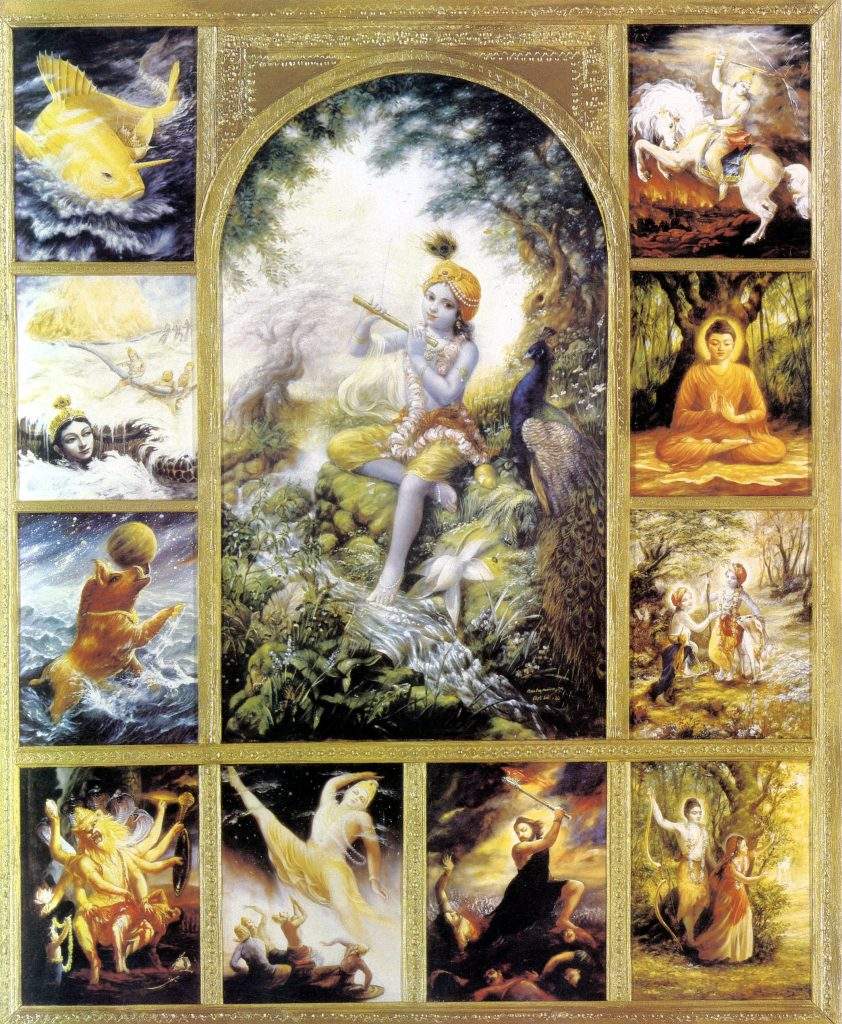
Aesthetic means conforming to the requirements of aesthetics and beauty.
Aesthetics examines how a person perceives beauty and what creates the feeling of aesthetic satisfaction. There is no doubt that beauty is important to all of us. The eternal pursuit of beauty is one of the signs that we come from a perfect world. It is said that the material world is only a distorted reflection of the spiritual world, so if we encounter beauty in this world, we must realize that its origins are in the spiritual kingdom. Throughout life, a person is led by the pursuit of harmony and beauty. Therefore, in various cultures, intelligent people have tried to understand the essence of beauty. In this respect, India also has much to boast of.
Purpose of Art
People think that art is meant to satisfy the senses. However, since the only enjoyer is Krishna, ultimately all art is meant to satisfy Him.
When Krishna was on earth, He Himself studied in a gurukula and very quickly learned all arts, sciences, and spiritual practice. In this way, He showed that education is an important thing.
Art is also not something that comes naturally on its own. One must learn art. All the gopis of Vrindavana, intimate friends of Krishna, were also very skilled in arts. The Brahma Samhita states that Radharani was also well versed in arts.
Art in India
Art is usually divided into 'high' art and popular. In Indian culture, such a distinction is visible since ancient times. 'High' art is called ‘marga’, and folk art – ‘deshi’. It is said that Shiva and Brahma 'handed down' (druhinena), and sage Bharata practiced (prayuktam) this high art, which grants liberation (vimukti-dam). However, art that serves mundane entertainment (lokānurañjakam) according to local customs (deshasthaya-rtya) is called local or folk art (deshi). This distinction also appears in dance types. For example, nritya – dance that reveals the meanings of words through gestures and conveys rasa, bhāva, and vyañjana; and nritta – purely decorative dance that does not convey any rasa.
One of the greatest theorists of rasa was Srila Rupa Goswami, who in his time was recognized as an expert in Natya Shastra. Even today, scholars and art critics quote his writings on moods and relationships. Srila Rupa Goswami systematized Natya Shastra and showed that it primarily describes spiritual emotions and experiences. Therefore, the order of various rasas in terms of intensity has changed. While Bharata Muni treats the rasa of love or eroticism as the lowest emotional experience, Srila Rupa Goswami states that in a spiritual sense, conjugal love for God is the most perfect emotion and the most perfect relationship a living entity can experience. Peace, which materialists so seek, according to Srila Rupa Goswami, is the very beginning of spiritual experiences. Impersonalists, seeking liberation from all feelings, do not understand that spiritual emotions are the basis of life in the liberated state. Specifically, by experiencing spiritual emotions, the living entity can reach a state of bliss. Therefore, the Goswamis of Vrindavana wrote many books, dramas, and poems. They evoke aesthetic experiences and thus bring a person closer to the perfect personality Sri Krishna, who is the source of all relationships and experiences.
Rasavada – Indian Aesthetic Theory
Natya Shastra – the Vedic theory of aesthetics or beauty surpasses everything that has ever been created in this field. It is said that the author of Natya Shastra is Bharata Muni, who lived in the 3rd century BC. He was given inspiration and revelation by Lord Shiva himself, who is called Nataraja – the King of Dance. The word ‘natya’ means dance. Natya Shastra mostly speaks about drama and dance, in other words, movement. Indeed, dance is one of the most important means of human self-expression. It is said that dance is a natural expression of joy. In the "Brahma Samhita", it is stated that in the spiritual world, every movement is a dance, and every word is a song.
The Vedas state that there are three elements of life that generate feeling: karana, karya, and sahakarin. When transferred to art, these three elements of life manifest as vibhāva, anubhāva, and vyabhichāribhāva.
The Natya Shastra states that during a drama, various situations are created, which are called vibhāva – defining and describing the drama, during which the actor must use specific dramatic means (anubhāva) to create dominant emotional states (sthayibhāva).
These states are:
love (rati), mirth (hasa), sorrow (shoka), anger (krodha), energy (utsaha), fear (bhayanaka), disgust (jugupsa), and wonder (vismaya).
These dominant states (sthayibhāva) combine with transitory states (vyabhichāribhāva) and temperamental states (sattvikabhāva).
Vyabhichāribhāva manifests in 33 symptoms, such as disappointment, weakness, understanding, envy, dizziness.
Sattvikabhāva manifests in 8 symptoms: paralysis, sweating, horripilation, voice change, trembling, paleness, weeping, fainting.
The combination of dominant, transitory, and temperamental states creates the main sensation of the drama – rasa. ‘Rasa’ is translated as aesthetic experience, taste, mood, flavor.
Moods are also of eight kinds:
erotic (shringara), comic (hasya), pathetic (shanta), furious (raudra), heroic (vira), terrible (bhaya), odious (bibhatsa), marvelous (adbhuta), compassionate (karuna).
All these 8 rasas are directly related to the 8 dominant states (sthayibhava).
Natya Shastra, after describing how various states create the main sentiment (rasa) in appropriate circumstances (vibhāva), further describes what dramatic means (anubhāva) evoke those emotions. Separate chapters describe movements of various body parts, hand gestures, various steps, and various parts of the stage that have a specific load. It also describes various aspects of diction and metrics, moods of address, and intonation.
A spectator who encounters drama and experiences the corresponding rasa during it receives great benefit. It teaches duty to those bound by duty; it teaches love to those who seek love; it punishes the rude and uncultured; it teaches self-restraint to those seeking self-control; it teaches courage to the cowardly; it teaches nobility to the brave; it gives knowledge to the ignorant; it gives wisdom to the learned; it is relaxation for a king; it gives strength of mind to the disappointed. Thus, art or drama is specifically related to long life, intelligence, prosperity, and the education of people.
A spectator who enters such a theater permeated with rasa experiences aesthetic satisfaction and bliss, even though the main sentiment (rasa) may be anger or disgust.
In Indian art, great attention is paid to the audience. The spectator must be a ‘rasika’, that is, a person who knows how to appreciate art well, and also ‘sahridaya’, that is, one who has come with a desire to evaluate favorably, to learn, and to enjoy the richness of art.
This theory of rasa or aesthetic experience was developed and expanded over many centuries, just as individual forms of Indian art were developed. It should be mentioned that until recent times, Indian art was inseparable from religious culture. Painting, drama, music, literature, architecture, etc., all were directed not at the life of ordinary people, but at the pastimes of Krishna or His incarnations. The help of art is primarily sought to strengthen a person's spiritual experiences, and this serves their spiritual advancement. In these days, when art is highly secularized, it has lost its purpose as a factor that perfects a human being.
Dance
Dance in a general sense is a human reaction to rhythm. Indian classical dance involves the body and mind. It is a form of meditation and worship. To this day in Jagannatha Puri, young girls are specially trained to dance for Lord Jagannatha.
Before starting the dance, Mother Bhumi (Earth) is greeted, as she tolerates the stomping of feet, and also the Guru and all participants who are in the dancer's heart are honored: "O Mother Earth, sustainer of living entities, honored by all demigods, worshipped by the enlightened, giving protection to those who seek your shelter, I come to you with a humble prayer: O Mother, please tolerate the stomping of my feet."
According to Abhinaya Darpanam, Sangitaratnakara, and other ancient works, dance is divided into three different categories: natya, nritya, and nritta.
Natya
Natya is related to drama. It is a dramatic representation with speech, music, and dance. It is a valued art whose theme is often a traditional story.
Nritya
Nritya is related to mimicry and interpretation. Dance that evokes emotion (bhāva), aesthetic feeling (rasa), and expression (abhinaya).
Nritta
Nritta – these are pure, rhythmic dance steps. The goal is to create beauty through forms and lines, without conveying specific mood or meaning.
Main Classical Dance Forms
Bharat Natyam
Named after the author of Natya Shastra. BHAva – feeling, RAga – melody, TAla – rhythm, NATYAM – dance. Origin: South India (Tamil Nadu). Depicts religious themes. A developed system of gestures (37 hand), poses (13 head, 36 eye).
Kathakali
Lyrical South Indian (Kerala) dance. Characterized by intense footwork, acrobatic energy, and highly stylized pantomime.
Kathak
Intricate North Indian dance, derived from the word ‘katha’ – story. Initially performed in temples by storytellers, later became court entertainment.
It is the dance of 'life', symbolizing creation and destruction. Poses are rarely static, resembling flow. Two-dimensional (straight lines). The style is divided into Nritta/Abhinaya and Tandava/Lasya.
Manipuri
Origin: Manipur (North East). Characterized by a moderate lyrical style.
Odissi
Romantic dance of love and passion.
Kuchipudi
Origin: Andhra Pradesh, South India.
Mohini Attam
Origin: Kerala, South India.
All these dance schools started from Natya Shastra, later they were described in more detail in books such as "Abhinaya Darpana", "Sangita Ratnakara", and "Hastalakshana Dipika". Another way to transmit the art of dance was guru-shishya parampara, when a student learned all the principles of dance from their teacher.
Nayaka and Nayika – Hero and Heroine
Nayika (heroine) is the main character portrayed in Indian dance. Various shades of love for her Lord (Nayaka) classify her into various nayika types. Similarly, there exist various nayaka – hero types.
Nayika actually means a loving woman. Nayika is usually a devotee who is separated from her Lord, Nayaka (God or Deity) and yearns to meet Him again. The devotee is the eternal nayika and God is the eternal nayaka. The dancer expresses every mood of a woman longing for her beloved. Depending on the mood or state she is in relation to her beloved, nayikas are divided into 8 types (ashtanayika):
Vasakasajja
Uchite vāsakeyātu rati sambhog lālsa
Mandanam kurute hrushtāhā sāvai vāsakasajjā
Prepares to meet her beloved. Adorns herself and decorates
the surroundings. Activity: looking into a mirror,
decorating the bed, waiting by the window.
(Also called: Vasaka sajjika, Sajjita)
Virahotkanthita
Anekakārya vyasangāt yasyā yasyeta na āgachchatti
Priyakaraha yasyā na āgamana tasyā dukhārtā virahotkanthitā
Suffers from separation. Feels lonely and grieves. Activity:
anxiety, tears, depression, exhaustion.
(Also called: Utkata, Utka, Utkanthita)
Svadhinabhartruka
Surtā atirasaihi baddho yasyāhā pārshvagataha priya
Sāmode guna sanyuktā bhaveta svādhinabhartruka
Happy and proud, her beloved is completely devoted to her.
Worships the God of Love because her hero is faithful and
always by her side.
(Also called: Svadhinapathika)
Kalahantarita
Irshyā nishkrānto yasyā na āgachchati
Amarshavarsha santaptaha kalahantaritā bhaveta
Fought over a trifle and remained alone. Mocked her beloved,
now regrets. Activity: repentance, sighing, anxiety.
(Also called: Abhisadhita, Kopita)
Khandita
Vyasangāt uchite yasyā vāsake na āgachchata priya
Iditadana āgamanārdu Khaṇḍite abhidhiyate
Furious over infidelity. Beloved came after spending the night with another. Activity: anger, insult, indifference to His sweet words.
Vipralabhdha
Tasmāt bhuta priya prāpya gatvā sanketameva
Na āgataha kāranen Vipralabdhātu sāmata
Disappointed by waiting. Nayaka did not come to the meeting. Activity: feeling of deception, suffering, broken heart.
Proshitabhartruka
Gurukāryāt vaśāta yasyās viproṣitā
Priyasā rudhālakāḥ keshātaha bhaveta proshitabhartrukā
Beloved has gone on a long journey. Activity: insomnia,
neglected appearance, unbraided hair, counting days.
(Also called: Proshitapriya)
Abhisarika
Hitvā lajjā samā iśtā maden madnenvā
Abhisāriryate kāntā sā bhavet Abhisārikā
Boldly goes to meet her beloved. Abandons modesty, overcomes all obstacles.
Divabhisarika: Goes out during the day (pretends to go for water).
Jyotsnabhisarika: Goes out during full moon, in white clothes.
Tamobhisarika: Goes out in darkness, in black clothes.
Nayika Classifications
By Gunas (Qualities)
- Uttama (superior) – maintains balance, controls herself, behaves well regardless of beloved's behavior.
- Madhyama (intermediate) – treats the beloved as he treats her.
- Adhama (inferior) – lacks self-restraint, responds with anger and envy.
By Maturity (Age)
- Mugdha (innocent) – young, inexperienced, shy. (jñāta yavana – 18-19 yrs, ajñāta yavana – 13-14 yrs).
- Madhya (adolescent) – partially experienced, desires and shyness are equal.
- Pragalbha (mature) – mature, beauty has blossomed, capable of expressing feelings.
By Temperament (Madhya/Pragalbha)
- Dhira (restrained) – sarcastic or indifferent, but respectful.
- Dhiradhira (partially restrained) – reproaches with tears or vacillates between faithfulness and caution.
- Adhira (unrestrained) – screams, scolds, or expresses anger by hurting.
By Type
- Sviya / Svakiya – married and faithful only to her Lord.
- Parakiya / Anya – married but loves another.
- Samaya / Sadharana – belongs to anyone, but skilled in arts.
By Relationship with Hero
Nayaka bhedam – different Nayaka (Hero) types
By Type
- Pati (husband) – married and faithful.
- Upapati (paramour) – married but in love with another.
- Vaisika – pays for women and enjoys them.
By Character of Love
- Anukula / Atula – faithful only to his wife.
- Dakshina – impartial, has several wives and treats them equally.
- Shatha – deceitful, his love is known to all.
- Drishta – shameless, unfaithful, and causes harm.
By Qualities
Cool, happy, carefree. Artist of love, good-mannered.
Noble, cool, without false ego, forgiving.
Passionate, capable, ambitious, but fickle and proud.
Gracious, virtuous, cool, and of good character.
Abhinaya
Arthānāmbhimukhikaranam abhinayaśabdārtham
The Sanskrit term "abhinaya" literally means "to carry towards" (prefix "abhi" means towards something, and root "ni" means "to carry"). Thus, conveying an idea to the spectator or otherwise teaching the spectator is called abhinaya.
Abhinaya Darpanam means that actors teach the spectator by stimulating the latent aesthetic experience potential in them. It is a method of presentation capable of invoking the psychological state of the character in the drama or dance. The goal is to provide the spectator with aesthetic satisfaction.
Abhinaya is also defined as "movements showing rasa and bhava (psychological states)". Four types of abhinaya are distinguished:
Angika Abhinaya (Physical)
Tatra āngikongainirdaśitaha
Shown with the help of body parts. It is the use of gestures and body gesticulation (as described in scriptures) to convey the thought and theme of the dance. For example: gestures with one hand, gestures with two hands.
Vachika Abhinaya (Verbal)
Vācā viracitaḥ kāvyanātakādi tu vācikaha
Consists of kavya (poems) and nataka (dramas). These are appropriate words, pronunciation, voice modulations, accent, and rhythm. For example: songs, dialogues in dramas.
Aharya Abhinaya (Costume)
Āharyo hārkeyurveśādibhirankrutihi
Body decoration, costumes, makeup, stage decorations. Very important for portraying the character of the story (e.g., in Kathakali dance).
Sattvika Abhinaya (Internal)
Sāttvikaha sāttvikair bhāvair bhāvajñena na vibhavitaha
Related to internal emotions (Sattva – purity). It is the expression of psychological states that create Rasa.
Rasa and Bhava
Aesthetics is the philosophy of art. It speaks of beauty in art, its understanding or enjoyment, and also of the perception of joy that accompanies the experience of beauty. To evoke Rasa within the spectator was the sole goal of all art forms: dance, drama, music, sculpture, painting, etc.
Rasa
To create Rasa means to give aesthetic satisfaction or to give an experience of bliss and joy. The word Rasa has no equivalent in Western languages. However, it can be translated as taste, enjoyment, feeling (sentiment).
Rasa is a mood or emotion that the dancer creates among the spectators, using Angika movements.
Importance of Rasa
Any art without Rasa is incomplete. Dance without Rasa will be only mechanical exercises or physical body movements. Only when dance succeeds in evoking Rasa does it rise above the level of mere physical effort and become a meaningful and creative activity.
“Rasa iti kaha padārthaḥ ucyate āsvādyatvāt ll”
That is, just as a well-disposed person enjoys the taste of food with spices and gets satisfaction, so does the spectator, immersed in the performance, enjoy the Sthayi Bhavas and rejoice.
Bharata's "Natya Shastra" gives the following Rasa Sutra:
“Vibhāvanubhāvyabhichārisanyogādrasaniṣpattiḥ ll”
The combination of Vibhavas (Determinants), Anubhavas (Consequents) and Vyabhicharibhavas (Transitory States) leads to Rasa.
Bhava
Literally Bhava means to become or that which becomes (bhu, bhava i.e. to become). In dance, it means the emotional states of the portrayed character. When bhavas are perceived, Rasa is born.
Sthayi Bhava
Permanent state of mind. Pervades all scenes of action in dance or drama. Innate in the human heart.
Vibhava (Determinant)
Alambana: The object or character responsible for the aroused emotions (e.g., the beloved).
Uddipana: The environment that enhances the emotional effect (e.g., garden, moonlight).
Anubhava (Consequent)
Physical changes and movements (conscious or unconscious) that convey the emotion outwardly (e.g., eyebrow movements, trembling).
Vyabhicharibhava
Transitory moods (33 types) that strengthen the dominant mood (Sthayi Bhava).
E.g.: Nirveda (renunciation), Glani (weakness), Shanka (apprehension), Asuya (envy), etc.
Navarasa – Nine Rasas
According to Bharata there are 8 rasas, but later a 9th (Shanta) was acknowledged.
| Rasa | Sthayi Bhava | Meaning | Color |
|---|---|---|---|
| Shringar (erotic) | Rati | Attraction | Pale Green |
| Hasya (comic) | Hasa | Laughter | White |
| Karuna (pathetic) | Shoka | Sorrow | Grey |
| Raudra (furious) | Krodh | Anger | Red |
| Vira (heroic) | Utsaha | Heroism | Pale Orange |
| Bhayanaka (terrible) | Bhaya | Fear | Black |
| Bibhatsa (odious) | Jugupsa | Disgust | Blue |
| Adbhuta (marvelous) | Vismaya | Wonder | Yellow |
| Shanta (peaceful) | Rami | Peace | White |
Verse about 9 Rasas
Shringãram kshithinandiniiviharane viiram dhanurbhanjane
Kãrunyam hanumantham adbhutharasam sindhau girisdhãpane
Hãsyam shuurppanakhãmukhe bhayamakhe biibhatsamanyãmukhe
Raudram rãvanamarddane munijane sãntham param pãthunah
He, whose body is embraced by Shringara feelings when standing next to Sita;
He is embraced by Vira emotion when he breaks the mighty bow;
He is embraced by Karuna emotion when he protects the crow;
He is embraced by Adbhuta feelings when looking at the bridge built of stones;
He is embraced by Hasya when observing Shurpanakha;
With Bhayanaka and Bibhatsa (and Raudra) he kills Ravana;
With Shanta emotion he gazes at the sages;
May He, Lord Rama, protect us!
Among the eight Rasas, four Rasas are the source of the other four rasas: Shringara arises from Hasya, Karuna arises from Raudra, Adbhuta arises from Vira, and Bhayanaka arises from Bibhatsa.
All rasas provide a broad framework for representation, but Shringara Rasa in its manifestation provides the most opportunities for creating dance. In Indian art, "Antar bhakti – bahir shringara" (internal devotion – external expression of love) depicts love not as an earthly physical emotion, but as the highest longing of the soul to meet its Lord.
Margi and Deshi
Natya Shastra divides dances into two categories: Margi (classical dance) and Deshi (Folk or regional dance).
Margi (Classical)
Based on Natya Shastra teachings. Has a detailed repertoire transmitted through tradition. Requires special preparation.
Purpose: Religious, directed toward God.
Examples: Bharat Natyam, Kathakali, Kathak,
Odissi, Mohiniattam, Kuchipudi, Manipuri.
Deshi (Folk)
Regional, folk in nature. Simple steps, oriented toward celebration and community. Does not require special education.
Purpose: Entertainment, celebration
(weddings, harvest).
Examples: Bhangra, Garbha, Gidda, Chau, Rajasthani
dances.
Tandava and Lasya
These are two terms describing the energy of dance. Tandava is associated with Lord Shiva, and Lasya – with Goddess Parvati.
Tandava (Masculine)
Energetic, powerful movements, force and vigor (leaps, whirls). Symbolizes the creation, preservation, and destruction of the universe.
7 forms: Sandhya, Ananda, Kali (Shakti), Tripura, Sati (Shiva), Adhanari, Samhara.
Lasya (Feminine)
Delicate, soft and graceful movements. Signifies that which is beautiful and radiant. Narrates the emotions of love.
Many solo styles (Bharat Natyam, Odissi, Mohiniattam) originated from Lasya.
Classical Music
The principles of Indian music were presented in the verses of Sama Veda. The three components of music are rhythm (tala), harmony (drona), and the type of melody (raga). These principles are interpreted uniformly throughout classical music.
Drona (Harmony)
This is a constant sound that resonates throughout the entire concert. Unlike Western harmony, drona is a reference point (base) that allows the musician to return to the theme after improvisation.
Raga (Melody)
"The framework of melody." Halfway between free improvisation and a defined melody. Associated with mood, time of day, season. Has strict rules, but allows infinite variation.
Tala (Rhythm)
Rhythmic structure, a cycle. Divided into equal parts with subgroups (beat/tali and pause/khali). The tabla player varies widely, but maintains the basic rhythm structure.
Main classical music traditions:
Hindustani school (North India) and Karnataka school (South India, characterized
by very strict traditions).
Vedic Arts (64 Arts)
Literature
- P. A. Grintser, Basic Aesthetic Principles of Classical Indian Poetics (1987) [in Russian].
- Ananda K. Coomaraswamy, The Transformation of Nature in Art (1934) [in English].
- Antanas Andrijauskas, Beauty and Art (1996), Vilnius Academy of Arts Press [in Lithuanian].
- Abhinavagupta – prominent representative of Indian art theory.
Self-Check Questions
- What is art, what is its purpose?
- What does the word rasa mean and how is this word related to art?
- Should devotees be interested in art?
- How is art related to spiritual perfection?