What is the Absolute
Definition of the Absolute (Webster's Dictionary)
- Free from imperfections (perfect); free from mixture (pure)
- A person completely unrestricted by any rules, exceptions, or qualification
- Fundamental or ultimate; perfectly embodying the essence of a thing
- Self-sufficient and independent of external references or connections
The opposite of absolute is relative.
Absolute Idealism – a 19th-century Western philosophical movement
We will briefly review the statements of this movement's representatives and their links with Vedic philosophy.
Hegel
The Absolute Idea is that of which we are all a part and towards which we move along the path of knowledge. The Absolute is that with which everything is connected, and which at the same time is completely self-sufficient. (Speculative method)
Schelling
The idea of the Absolute is a unity of all opposites, without properties and indivisible. This idea very much resembles the Mayavada conception of the Absolute as an undifferentiated substance, Brahman.
Royce
Our minds are fragments of the Absolute, capable of maintaining their personal individuality. Individual beings can use their virtues to strive for an ever wider perception of the Absolute.
The Absolute as Unity and Cause
We see that in the world around us, every object or phenomenon has its cause. Even empirical (sensory) experience forces scientists to look for common fundamental patterns in the structure of this world. In seeking more general knowledge, we can expect that we will arrive at a unified cause of the phenomenal world. This cause, being primary, can no longer have other conditions for its emergence within itself, and therefore can be called the absolute cause.
īśvaraḥ paramaḥ kṛṣṇaḥ
sac-cid-ānanda-vigrahaḥ
anādir ādir govindaḥ
sarva-kāraṇa-kāraṇam
Krishna, known as Govinda, is the Supreme Personality of Godhead (īśvara). He has an eternal, blissful spiritual body (vigraha). He is the source of everything (ādir). He himself has no source and is the prime cause of all causes (kāraṇa kāraṇam).
— Brahma-samhita 5.1
The Absolute as Non-dualism
From the Vedic point of view, the Absolute is non-dual. He is not good or bad, He knows no happiness or misfortune. He depends on nothing, and everything depends on Him. He is the Absolute, and in Him exists everything that is experienced by the senses, what can be thought by the mind, and what can be experienced by the soul.
Important to understand
The Absolute is the source of all qualities and relationships, which means that He has qualities and relationships. He cannot be impersonal (having no qualities and relationships), because then He would lack a large part of what even simple conditioned souls possess. On the other hand, He cannot be only personal, since that would also be only one side of dualism. Thus, the Absolute must be both personal and impersonal.
Krishna's body is absolute
Lord Krishna's Supreme position: BG 3.22 says that in all the three planetary systems there is no work for Krishna to perform, and he lacks nothing.
tam īśvarāṇāṁ paramaṁ maheśvaraṁ
taṁ devatānāṁ paramaṁ ca daivatam
patiṁ patīnāṁ paramaṁ parastād
vidāma devaṁ bhuvaneśam īḍyam
"He is the supreme controller, and all controllers are but His authorized personalities. Even the demigods worship Him. His body and soul are no different. All His senses are transcendental, and each can perform the work of the other."
— Śvetāśvatara Upaniṣad 6.8
In the Kurma Purana it is said that He is homogeneous, i.e., there is no difference between Himself, His body, and His mind: deha-dehi-vibhedo 'yaṁ neśvare vidyate kvacit.
Krishna's body is transcendental; therefore, one of his senses can replace another. In the Brahma-samhita (5.32) it is stated:
aṅgāni yasya sakalendriya-vṛttimanti
paśyanti pānti kalayanti ciraṁ jaganti
ānanda-cinmaya-sad-ujjvala-vigrahasya
govindam ādi-puruṣaṁ tam ahaṁ bhajāmi
"I worship Govinda, the primeval Lord, whose transcendental form is full of bliss, truth, and substantiality. Each of the parts of that transcendental figure possesses all the functions of all the organs."
The Absolute is immutable
Being absolute, Krishna does not change, even though so many actions are performed by the help of His energies. The invocation mantra of the Isopanisad says:
oṁ pūrṇam adaḥ pūrṇam idaṁ
pūrṇāt pūrṇam udacyate
pūrṇasya pūrṇam ādāya
pūrṇam evāvaśiṣyate
"The Personality of Godhead is perfect and complete, and because He is completely perfect, all emanations from Him, such as this phenomenal world, are perfectly equipped as complete wholes. Whatever is produced of the Complete Whole is also complete in itself. Because He is the Complete Whole, even though so many complete parts emanate from Him, He remains the complete balance."
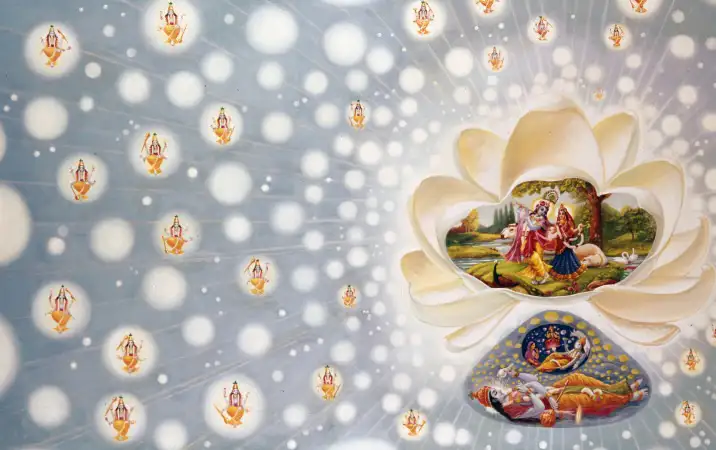
From Krishna emanate countless expansions: Nārāyaṇa in the Vaikuntha worlds, Vishnu in every universe and in the heart of every living being, and numerous avatars. All these expansions are called the Supreme Personality of Godhead, yet Krishna, from whom these expansions emanate, remains just as complete and unchanged.
Absolute Truth
Krishna is the Absolute Truth. We call "truth" that which truly exists. However, the only one who truly is – is Krishna. Everything else emanates from Him and depends on Him. Krishna maintains the entire creation by His mere thoughts. That which Krishna forgets immediately ceases to be.
oṁ namo bhagavate vāsudevāya
"O my Lord, Sri Krishna, son of Vasudeva, I offer my respectful obeisances unto You. I meditate upon Lord Sri Krishna because He is the Absolute Truth and the primeval cause of all causes."
— ŚBh 1.1.1
Krishna – the cause of everything
Brahma-samhita and BG 7.6 say that Krishna is the source of both creation and destruction. He is the beginning and the end of all that is material and spiritual in this world. BG 7.7 says that there is no truth superior to Krishna.
Krishna – the great destroyer
Krishna also destroys everything. He is time – the great destroyer of worlds. Katha Upanishad 1.2.25 states that in the end, everything living: brahmanas, kshatriyas, etc., are devoured by the Supreme like food.
The Absolute as the Whole
In fact, Krishna is the essence of everything. Everything we see or are able to accept as a distinctive quality of an object depends on Krishna. This means that Krishna Himself gives all things their essence (BG 7.9). Indeed, Krishna is everything, because nothing has a separate existence without Krishna. Everything that exists is only the manifestation of His energies (BG 9.16-19).
Krishna is everywhere and in everything
Lord Narasimha appeared from a palace column. It means nothing to Him to transform matter into spirit and vice versa. The Lord is both near and very far. Everything is in Him and He is in everything. He even enters into atoms as the Supersoul, causing electrons to rotate around the nucleus and planets to float in cosmic space. Just as the wind is always in space, so all living beings are in Him (BG 9.6).
At the same time, Krishna warns not to identify Him with material objects or phenomena. He is the basis of everything, but everything is His energy, and not Himself. He says that everything is in Him, but He is not in all that (BG 9.5). How Krishna is everything is best described by Arjuna (BG 11.40): sarvaṁ samāpnoṣi tato 'si sarvaḥ – since You cover everything, You are everything.
The Absolute as a Goal
Krishna is inconceivable by the mind and senses. He is avyakta-mūrti – unmanifested in the material world (BG 9.4).
tad ejati tan naijati
tad dūre tad v antike
tad antar asya sarvasya
tad u sarvasyāsya bāhyataḥ
"The Supreme Lord walks and does not walk. He is very far away, but He is also very near. He is within everything, and yet He is outside of everything."
— Īśopaniṣad 5
Krishna does not reveal Himself to fools
BG 7.25 says:
"I am never manifest to the foolish and unintelligent. For them I am covered by My internal potency, and therefore they do not know that I am unborn and infallible."
The Absolute as purity
Krishna is pure – antiseptic, śuddham. This means that everything that comes into contact with Him becomes clean, although the Lord Himself is not contaminated by it. He is not subject to the impurity of matter or consciousness, because He is the source of matter and consciousness.
The Absolute as the sole Master
Krishna is not subject to the modes of material nature; He is above them. BG 7.12 says that all states of being – be it goodness, passion, or ignorance – are manifestations of His energy. On the one hand, Krishna is everything, yet He is independent. He is not controlled by the modes of material nature; on the contrary, they dwell in Him.
Krishna is the source of all incarnations
ete cāṁśa-kalāḥ puṁsaḥ
kṛṣṇas tu Bhagavān svayam
indrāri-vyākulaṁ lokaṁ
mṛḍayanti yuge yuge
"All of the above-mentioned incarnations are either plenary portions or portions of the plenary portions of the Lord, but Lord Śrī Kṛṣṇa is the original Personality of Godhead."
— Śrīmad Bhāgavatam 1.3.28
Three aspects of the Absolute
Thus Krishna is the Supreme Personality of Godhead. However, transcendentalists can know Him differently. Śrīmad Bhāgavatam 1.2.11 says:
vadanti tat tattva-vidas
tattvaṁ yaj jñānam advayam
brahmeti paramātmeti
Bhagavān iti śabdyate
"Learned transcendentalists who know the Absolute Truth call this nondual substance Brahman, Paramātmā or Bhagavān."
Brahman
Students of the Upanishads, jñānīs, know the Absolute as Brahman – the impersonal effulgence of Krishna's body. This is like the view of a mountain from afar – very generalized.
Paramātmā
The Hiranyagarbhas or yogis see the Absolute as Paramātmā – the Supersoul, a partial manifestation of Bhagavān. This is like the view of a mountain from closer up – we see the details.
Bhagavān
Devotees, bhaktas, see the Absolute Truth as Bhagavān – the Supreme Personality of Godhead. This is like being on the mountain – we can experience all emotions and relationships.
The mountain analogy
An example is the view of a mountain, seen from far away, closer up, and on the mountain itself. From afar we can see the mountain itself, but the details will not be noticeable (Brahman). When we come closer, we see the whole picture – vegetation, relief (Paramātma). However, when we climb the mountain, we will be able to experience all emotions, touch, smell – our relationship becomes active (Bhagavān).
Result of worship
Those who see the Absolute Truth differently, and worship those different forms, achieve a corresponding result.
Sayujya-mukti
Those who worship Brahman achieve sayujya-mukti – merging into the effulgence of Brahman. This is the goal of impersonalists.
Eternal service
Those who worship Bhagavān achieve eternal loving service to the Lord in His spiritual abode. This is the goal of bhaktas.
Self-Check Questions
- What is the Absolute and how is it defined?
- Why is Krishna's body absolute?
- What are the three aspects of the Absolute?
- What is the difference between the realization of Brahman, Paramātmā, and Bhagavān?
- Why is Krishna the source of all incarnations?