All manifestations of Krishna are divided into three categories:
1. Svayam-rūpa
His personal forms in Goloka Vṛndāvana.
2. Tad-ekātma-rūpa
His various forms in the Vaikunthas (Paravyoma) and in the material world (jagad).
3. Āveśa-rūpa
His empowered personalities – śaktyāveśa-avataras. Usually, these are jīvas to whom Krishna grants His power.
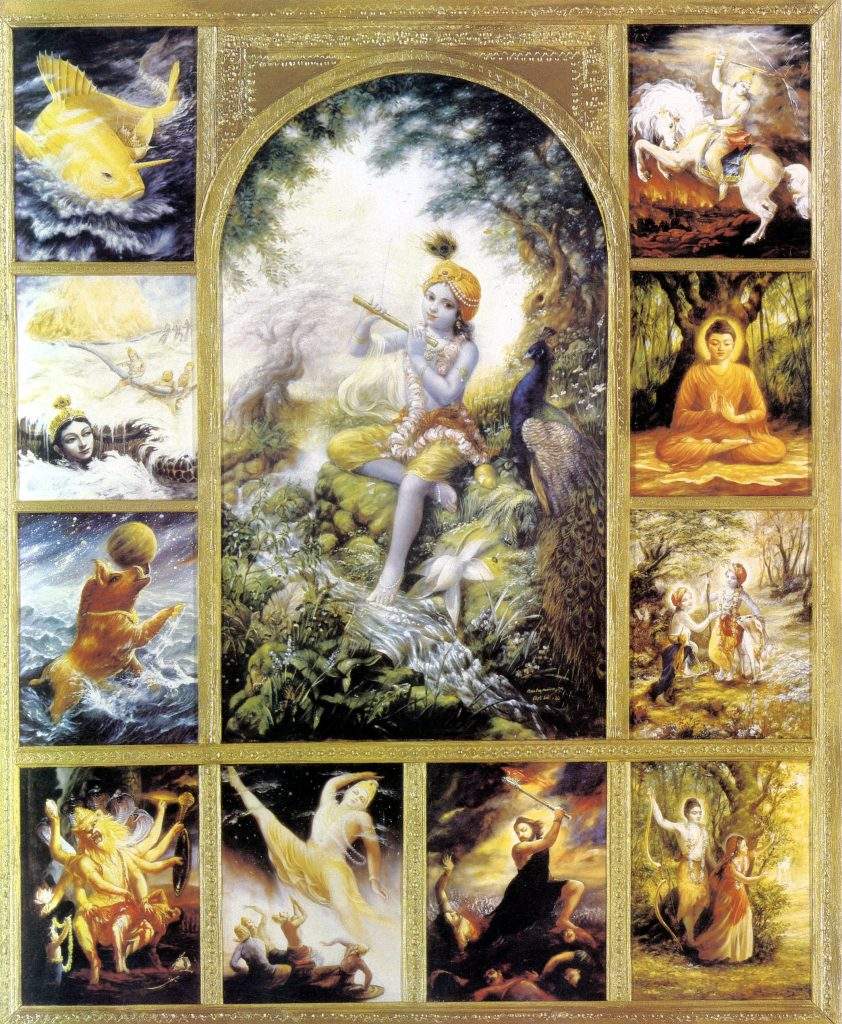
Avatari and Avatara
In the commentary to SB 1.3.28, Prabhupāda states that avatara means "one who descends". All incarnations of the Lord, as well as He Himself, descend to various planets of this world or various forms of life in order to fulfill a certain mission.
yadā yadā hi dharmasya
glānir bhavati bhārata
abhyutthānam adharmasya
tadātmānaṁ sṛjāmy aham
"Whenever and wherever there is a decline in religious practice, O descendant of Bharata, and a predominant rise of irreligion — at that time I descend Myself."
— Bhagavad-gita 4.7
paritrāṇāya sādhūnāṁ
vināśāya ca duṣkṛtām
dharma-saṁsthāpanārthāya
sambhavāmi yuge yuge
"To deliver the pious and to annihilate the miscreants, as well as to reestablish the principles of religion, I Myself appear, millennium after millennium."
— Bhagavad-gita 4.8
Important to know
All Avatars of the Supreme Personality of Godhead come in their original spiritual form and do not acquire a material body. Therefore, they are not conditioned by the illusion to which all living beings in the material world are subject.
Krishna's avatars in the material world are of 6 types:
1. Puruṣa-avatāras
Incarnations of Vishnu who create the material creation.
2. Līlā-avatāras
Incarnations of pastimes who perform various wonderful deeds.
3. Guṇa-avatāras
Incarnations controlling the gunas of nature (Vishnu, Brahma, Shiva).
4. Manvantara-avatāras
Incarnations of Manu, appearing in every Manu epoch (14 per day of Brahma).
5. Yuga-avatāras
Incarnations for different epochs (Satya, Treta, Dvapara, Kali).
6. Śaktyāveśa-avatāras
Empowered personalities to whom Krishna grants His power.
1. Puruṣa-avatāras
They create the material creation, all universes, all atoms, and living beings. The Puruṣa-avatāras, known as Vishnu, maintain this material creation by Their will. There are 3 puruṣas described by the Satvata-tantra:
Mahā-Viṣṇu
Creates the total material energy (mahat-tattva). He lies in the Kāraṇa-udaka – the Causal Ocean. As He exhales, countless universes dissipate from the pores of His skin.
Garbhodakaśāyī Viṣṇu
Enters into every universe and creates diversity within them. From His navel, a lotus grows, in which Brahma is born.
Kṣīrodakaśāyī Viṣṇu
He spreads as the all-pervading Supersoul in all universes. He is everywhere, even in atoms.
2. Guṇa-avatāras
Vishnu
Controls sattva-guṇa – goodness. Maintains the universe.
Brahma
Controls rajo-guṇa – passion. Creates the universe.
Shiva
Controls tamo-guṇa – ignorance. Destroys the universe.
3. Yuga-avatāras
Chapter 11.5 of SB speaks about yuga-avatāras:
Satya-yuga – White color (śukla)
Four-armed, with matted locks. This is Nara-Nārāyaṇa Ṛṣi.
Process of worship: Ascetic meditation, sense control (tapasa).
Treta-yuga – Red color (rakta)
4 arms, golden hair, triple belt.
Process of worship: Rituals and sacrifices according to the 3 Vedas.
Dvapara-yuga – Dark blue color (śyāma)
With yellow garments, the Śrīvatsa mark, and personal weapons.
Process of worship: Vedic and tantric injunctions.
Kali-yuga – Yellow color (pīta)
Gauranga – although His color is not blackish, He is Krishna Himself.
Process of worship: Congregational chanting of the Holy Name (saṅkīrtana).
4. Līlā-avatāras
They come to perform various pastimes. Their goal is to attract the attention of living beings through wonderful deeds or works. Srimad-Bhagavatam 1.3 lists 22 līlā-avatāras.
Ten Avatars (Daśa-avatāra)
SB 1.3.26 states that the Lord's incarnations are countless, like waves in the ocean, but ten primary ones are mentioned:
- Matsya – the fish who saved the Vedas
- Kūrma – the tortoise who held Mount Mandara
- Varāha – the boar who lifted the Earth
- Narasiṁha – the half-man, half-lion
- Vāmana – the dwarf brahmana
- Paraśurāma – Bhṛgupati
- Rāmacandra – the husband of Sītā
- Balarāma – the brother of Krishna
- Buddha – who gave religion to atheists
- Kalki – who will come at the end of the Kali age
25 Līlā-avatāras (from SB 2.7)
1. Varāha
The boar who emerged from Brahma's nostril
2. Suyajña
Took the post of Indra
3. Kapila
Author of Sankhya philosophy
4. Dattātreya
Son of Atri Muni
5. Catuḥsanas
The 4 Kumaras
6. Nara-Nārāyaṇa
Brahmacharis
7. Pṛśnigarbha
Appeared to Dhruva Mahārāja
8. Pṛthu Mahārāja
Restored order on Earth
9. Ṛṣabhadeva
Taught about austerities
10. Hayagrīva
Appeared in Brahma's sacrifice
11. Matsya
Protected the Vedas
12. Kūrma
Held Mount Mandara
13. Nṛsiṁha
Saved Prahlada
14. Hari
Saved Gajendra
15. Vāmana
Dwarf
16. Haṁsa
Taught Nārada Muni
17. Mohinī Mūrti
Enchanted the demons
18. Dhanvantari
Founder of Ayurveda
19. Paraśurāma
Destroyed the kshatriyas
20. Rāmacandra
Killed Rāvaṇa
21. Balarāma
Krishna's brother
22. Krishna
Supreme Personality of Godhead
23. Vyāsadeva
Divided the Vedas
24. Buddha
Gave religion to atheists
25. Kalki
Will come at the end of Kali
Self-Check Questions
- What does the word 'avatara' mean?
- What are the 6 types of avatars?
- Who are the three Puruṣa-avatāras and what are Their functions?
- What are the Yuga-avatāras and how are They worshipped?
- List the ten primary avatars (Daśa-avatāra).