Sources
- Bhagavad-gita 2.11-30
- Introduction to "Nectar of Devotion"
Origin of Living Entities
The source of living entities is Lord Sankarshana, who is an expansion of Balarama. For this reason Sankarshana is sometimes called Jiva. CC Adi 5.45 says that Sankarshana is the shelter of the jivas, but not their creator.
Question about the origin of the soul
Are tatastha shakti jivas eternally conditioned, or were they conditioned at some point?
Both views are well supported by shastras. Srila Prabhupāda always instructed not to delve too deep into this topic – the most important thing is that we are fallen and we need to get out of here.
Nature of the Living Entity
The spiritual soul is an infinitesimally small spiritual particle. It is called anu atma (atomic size) compared to the Supersoul, who is called Vibhu atma.
aṇor aṇīyān mahato mahīyān
ātmāsya jantor nihito guhāyām
tam akratuḥ paśyati vīta-śoko
dhātuḥ prasādān mahimānam ātmanaḥ
"Both the Supersoul and the atomic soul are situated in the same tree of the body within the same heart of the living being, and only one who has become free from all material desires as well as lamentations can, by the grace of the Supreme, understand the glories of the soul."
— Katha Upanishad 1.2.20
Size of the Soul
Shvetashvatara Upanishad (5.9) says: "When the upper point of a hair is divided into one hundred parts and again each of such parts is further divided into one hundred parts, each such part is the measurement of the dimension of the spirit soul." These measurements should not be taken literally – the comparison with a hair is given to show how infinitesimally small the soul is.
Qualities of the Soul (Bg. Chapter 2)
Bg. 2.17
The soul is indestructible (avinashi) and immortal (avyayasya).
Bg. 2.18
The soul is immeasurable (aprameyasya) and eternal (nityasya).
Bg. 2.20
The soul is not born (na jayate) and does not die (na mriyate). It is unborn (aja), eternal (nitya), ever-existing (puranah).
Bg. 2.24
The soul is unbreakable (acchedyah), insoluble (akledyah), eternal (nityah), unchangeable (sthanuh), immovable (sanatanah).
vāsāṁsi jīrṇāni yathā vihāya
navāni gṛhṇāti naro 'parāṇi
tathā śarīrāṇi vihāya jīrṇāny
anyāni saṁyāti navāni dehī
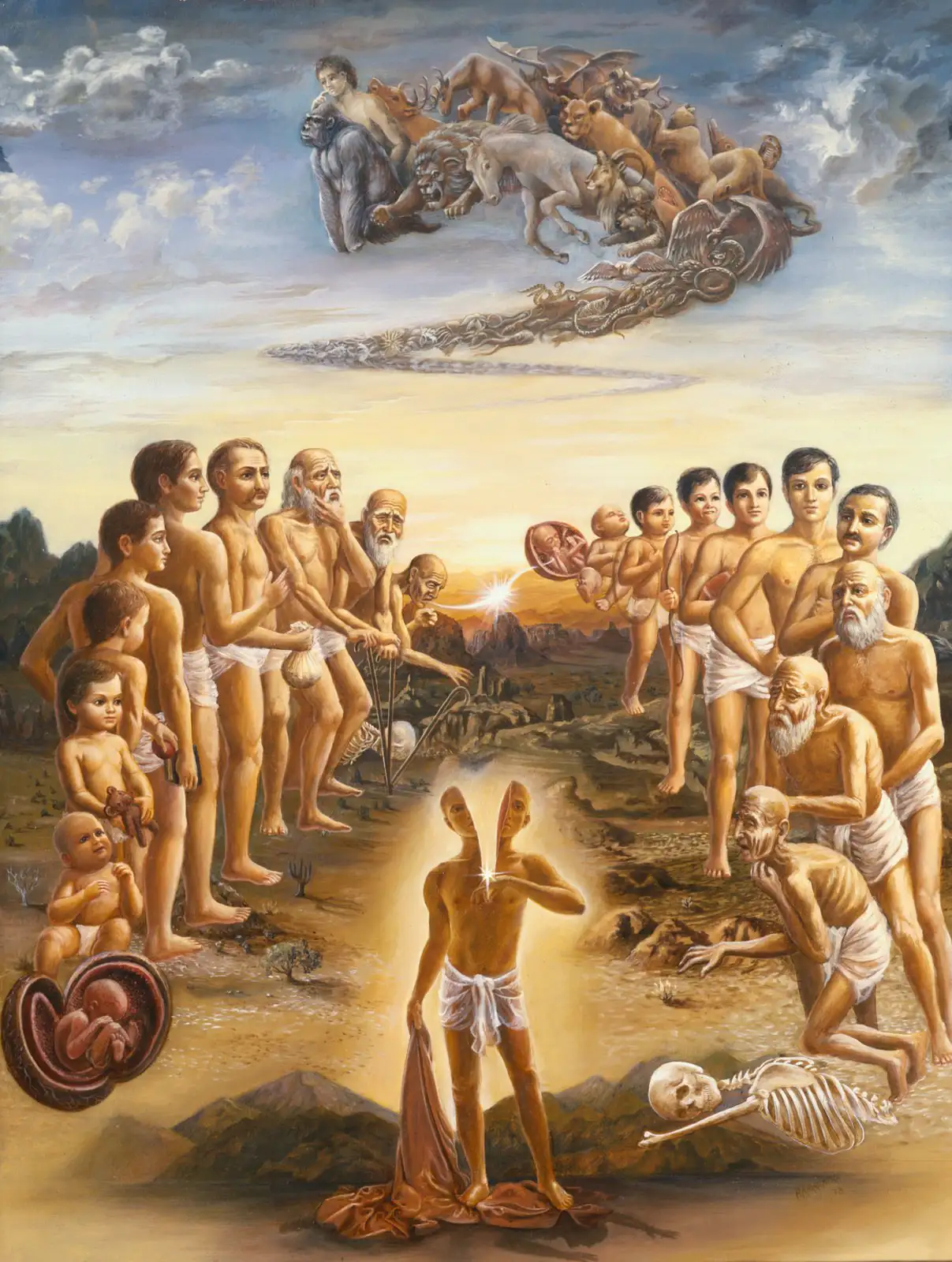
"As a person puts on new garments, giving up old ones, the soul similarly accepts new material bodies, giving up the old and useless ones."
— Bhagavad-gita 2.22
Dharma – Constitutional Duty
Every existing object has its purpose – that for which it was created. This object's purpose is called dharma or essential function. In the case of humans, dharma is the activity that is inherently characteristic of a particular position occupied.
Temporary Dharmas
Stri dharma, brahmana dharma, varnashrama dharma – all these dharmas are temporary because they are related to the material body. As the body changes, the dharma also changes.
Sanatana Dharma
Eternal activity of the soul – serving Krishna. It has no beginning and no end, is performed constantly, without breaks. This is the true nature of the soul.
jīvera 'svarūpa' haya — kṛṣṇera 'nitya-dāsa'
kṛṣṇera 'taṭasthā-śakti' 'bhedābheda-prakāśa'
"The constitutional position of the living entity is to be an eternal servant of Krishna, because it is the marginal energy of Krishna, manifesting as identical to Krishna and different from Him."
— Caitanya-caritamrita, Madhya 20.108
Sun and Rays Analogy
An example can be given with the Sun and sun particles. They are of the same nature, but at the same time the rays cannot equate to the Sun itself in power. Or fire and sparks – as long as the spark maintains contact with the fire, it burns brightly. However, as soon as it separates from the fire, it very quickly begins to extinguish.
QUESTIONS
- Explain in what way the soul is identical to God and how it is different from Him?
- What are the qualities of the soul?
- What do the words dharma and Sanatana Dharma mean?
- What does the constitutional nature of the soul mean?