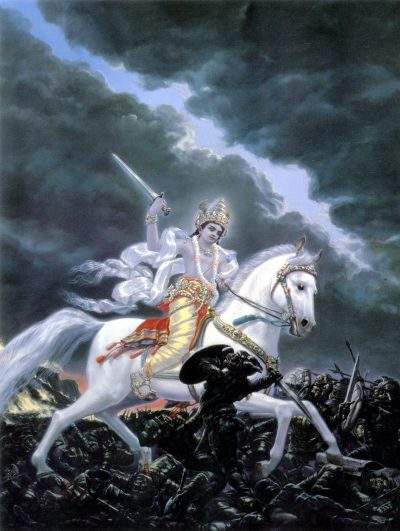
Expansions of Krishna
Krishna is the Supreme Personality of Godhead. He enjoys His transcendental pastimes in Goloka Vrindavana and has nothing to do with material nature. All forms of God emanate from Him and thus are not different from Him.
The Chain of Expansions
Krishna → Balarama → Adi chatur-vyuha (Sankarshana) → Chatur-vyuha (Sankarshana) → Maha Vishnu → Garbhodakashayi Vishnu → Kshirodakashayi Vishnu → Ananta Shesha
Krishna manifests His Narayana expansions, who maintain the planets of the spiritual world. Narayana expands Himself into the three Vishnus who create, maintain, and destroy all material universes. These three Vishnus are called purusha-avataras.
The Three Guna-Avataras
Brahma
Creation (rajas – passion)
Responsible for secondary creation in the universe.
Vishnu
Maintenance (sattva – goodness)
Oversees and maintains the entire creation.
Shiva
Destruction (tamas – ignorance)
Responsible for the destruction of the universe.
Primary Creation (sarga)
From the Lord's internal energy Rama emerges mahat-tattva – the cloud of contaminated consciousness. It appears at the Lord's desire (sa aikṣata bahu 'syām). This mahat-tattva is impregnated with living beings by the Lord's glance.
The Emergence of the Three Gunas
Mahat-tattva, stirred by the time factor (Krishna), created the three gunas, whose interaction creates everything that moves and does not move in this world:
Sattva
Goodness
Rajas
Passion
Tamas
Ignorance
The Three Powers of Material Energy
Dravya shakti
Material element base
Kriya shakti
Acting / moving power
Jnana shakti
Power of perception and knowledge
False Ego (ahankara)
Within the mahat-tattva, over time, the false Ego – ahankara – manifested, embodied by Lord Shiva. False Ego means identifying oneself with the lower energy.
Vaikarika
Ego in goodness
Created the mind and the demigods governing directions, air, Sun, rain, and fire.
Taijasa
Ego in passion
Created the intelligence and the ten senses: five perceptive and five active.
Bhuta
Ego in ignorance
Created the sense objects and the gross elements.
The Five Perceptive Senses
| Sense | Organ | Governing Deity |
|---|---|---|
| Hearing | Ears | Dik-pala (Direction governors) |
| Touch | Skin | Vayu (Air god) |
| Sight | Eyes | Surya (Sun god) |
| Taste | Tongue | Varuna (Water god) |
| Smell | Nose | Ashvini-kumaras |
The Five Working Senses
| Sense | Governing Deity |
|---|---|
| Hands | Agni |
| Legs | Vishnu |
| Voice | Indra |
| Anus | Mitra |
| Genitals | Brahma (Prajapati) |
The Five Gross Elements (pancha bhuta)
From the ego in the mode of ignorance arose the gross elements with their qualities:
Akasha
Ether
sound
Vayu
Air
sound + touch
Agni
Fire
+ form
Apah
Water
+ taste
Bhumi
Earth
+ smell
24 Principles of Creation
Maha Vishnu created 16 principles of creation:
- 5 material elements (pancha bhuta)
- 5 working senses
- 5 information-gathering senses
- Mind (the sixth sense)
Together with prakriti, mahat-tattva and ahankara, the 11 senses and 5 sense objects, and 5 gross elements constitute the 24 ingredients of the material world.
Secondary Creation (visarga)
First, the Lord entered each universe as Hiraṇyagarbha – the golden Lord. He is the form of the universe, and various parts of His body symbolize various planetary systems.
The Birth of Brahma
From the navel of Garbhodakaśāyī Viṣṇu grew a lotus, in whose stem all 14 planetary systems are located. The crown of the lotus symbolizes the abode of Lord Brahma. Lord Brahma was born in this lotus flower without a father or mother, directly from Viṣṇu, therefore he is called Svayambhū – born from himself.
Brahma's Creation
Lord Brahma, the first living being in the universe, began to create by connecting souls with certain material forms. He created mentally and physically by chanting mantras.
The Five Elements of Ignorance (SB 3.20.18)
- Moha – self-delusion
- Andha Tamisra – fear of death
- Tamisra – frustration from anger
- Maha Moha – sense of false ownership
- Tamas – forgetfulness of one's real nature
The Ten Sons of Brahma
| Son | Source of birth |
|---|---|
| Narada | Brahma's mind |
| Vasishtha | Brahma's breath |
| Daksha | Brahma's thumb |
| Bhrigu | Brahma's touch |
| Kratu | Brahma's hand |
| Pulastya | Brahma's ear |
| Angira | Brahma's mouth |
| Atri | Brahma's eyes |
| Marici | Brahma's mind |
| Pulaha | Brahma's navel |
Other Creations of Brahma
- The four Vedas, four principles of religion, four social classes
- Medical science, military science, the art of music and architecture
- The fifth Veda (puranas) and histories
- Pranava omkara – from his heart
- Svayambhuva Manu and his wife Shatarupa
- Gandharvas and Apsaras
- Ghosts and spirits
- Siddhas and Vidyadharas
Maintenance
Lord Vishnu maintains the entire creation. He is Kshirodakashayi Vishnu – the Supersoul in the heart of every living being and in every atom.
Destruction
Lord Shiva is responsible for the destruction of the universe at the end of each Brahma's day and the final destruction at the end of Brahma's life.
QUESTIONS
Self-Check Questions
- Tell about the three Vishnu expansions and their characteristics.
- Why is the Lord called purusha?
- Explain in general terms how the material world creation process took place. What were the primary (sarga) and secondary (visarga) creation processes?
- What is time?
- Mention facts and figures related to Universal time: Brahma's life, Brahma's day, demigods' day and night, the duration of each yuga.
- Why does civilization degrade rather than progress?