Jaiva Dharma (Chapter 13)
Vrajanatha: Babaji, I have fully understood that the Veda, which is knowledge that is svatah-siddha (self-evident), is pramana. Some logicians argue against the Vedas, but their efforts are fruitless. Now, be merciful and explain the second Dashamula tattva shloka.
Babaji:
haris tv ekaṁ tattvaṁ vidhi-śiva-sureśa-praṇamitaḥ
yad evedaṁ brahma prakṛti-rahitaṁ tat tv anumahaḥ
parātmā tasyāṁśo jagad-anugato viśva-janakaḥ
sa vai rādhā-kānto nava-jalada-kāntiś cid-udayaḥ
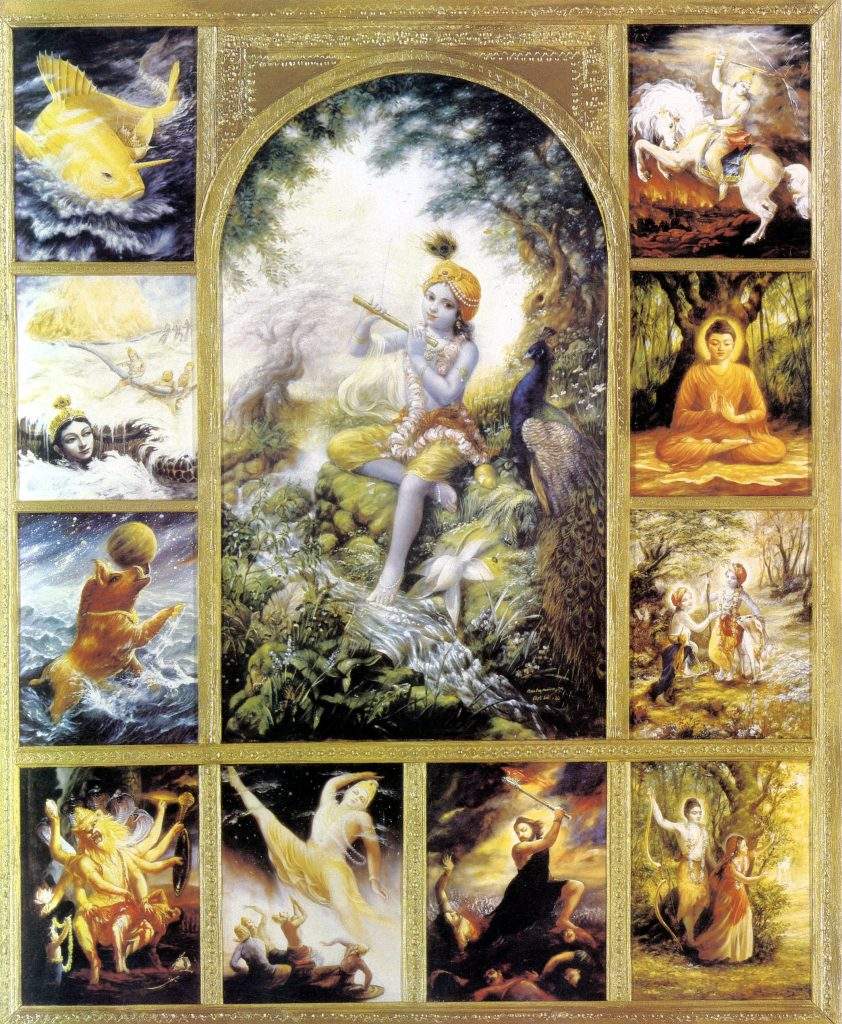
Indeed, Sri Hari, to whom Brahma, Shiva, Indra, and other devatas constantly offer pranāmas, is the only Supreme Absolute Truth. Nirvishesha-brahman, which has no shakti, is the effulgence of Sri Hari's body. Maha-Vishnu, who created the universe and who entered into it as the Supersoul residing in all, is simply His partial manifestation. It is Sri Hari alone who is the very form of transcendental reality (chit-svarupa), whose body is the color of a freshly formed storm cloud, and who is Sri Radha-vallabha, the beloved of Sri Radha.
The Nature of Bhagavan
Vrajanatha: The Upanishads describe brahman, which is transcendental to contact with matter, as the supreme truth; so, what arguments did Sri Gaurahari use to prove that brahman is the effulgence of Sri Hari's body?
Babaji: Sri Hari is indeed Bhagavan, whose true nature is confirmed in the Vishnu Purana (6.5.74):
aiśvaryasya samagrasya vīryasya yaśasaḥ śriyaḥ
jñāna-vairāgyayoś caiva ṣaṇṇāṁ bhaga itīṅganā
Bhagavan is the Supreme Absolute Truth, possessing six inconceivable attributes: all wealth, strength, fame, beauty, knowledge, and renunciation.
The Relationship between the Whole and the Parts
There is an interrelationship between the qualities of the whole (angī) and its parts (anga). The angī (the whole) is that which contains all the angas (the parts). For example, a tree is the angī, and the leaves and branches are the angas.
The angī-guna of the transcendental body of Bhagavan is His radiant beauty (śrī), and three qualities – wealth (aiśvarya), strength (vīrya), and fame (yaśa) are his angas (parts).
The Relationship between Brahman and Bhagavan
Vrajanatha: The qualities of impersonal nirvishesha brahman are described in many places in the Vedas, and at the end of these descriptions, the mantra 'oṁ śāntiḥ śāntiḥ, hariḥ oṁ' is always used, describing the supreme truth, Sri Hari. Who is this Sri Hari?
Babaji: This Sri Hari is actually chit-lila-mithuna (the combined form of Radha and Krishna), who perform divine pastimes.
Paramatma – a partial manifestation of Bhagavan
Vrajanatha: How is Paramātmā, the creator of the universe, a partial manifestation of Bhagavan?
Babaji: Pervading everything with His attributes of aiśvarya and vīrya (potency) and creating all the universes, Bhagavan enters each universe in His amsha (partial manifestation), Vishnu. Every amsha of Bhagavan always remains complete; none of them is ever incomplete.
pūrṇam adaḥ pūrṇam idaṁ pūrṇāt pūrṇam udacyate
pūrṇasya pūrṇam ādāya pūrṇam evāvaśiṣyate
The avatari-purusha (the source of all avatars) is complete and perfect. Since He is perfectly complete, all the avatars emanating from Him are also complete. In no way does this Parameśvara suffer any diminution.
— Bṛhad-āraṇyaka Upaniṣad 5.1 / Īśopaniṣad
Kāraṇodakaśāyī Viṣṇu
He lies in the Causal Ocean or the Viraja River, which stretches between the cit and māyika worlds. From here, He glances at māyā, and the material world is created.
Garbhodakaśāyī Viṣṇu
The power of Kāraṇodakaśāyī Viṣṇu's glance, which enters māyā, becomes Garbhodakaśāyī Viṣṇu. He enters into every universe.
Kṣīrodakaśāyī Viṣṇu
In the heart of every jīva, Īśvara is present as the thumb-sized Kṣīrodakaśāyī Viṣṇu expansion, also known by the name Hiraṇyagarbha.
Krishna – Svayam Bhagavan
Vrajanatha: I understand that brahman is the effulgence of Sri Hari's body, and that Paramātmā is His portion. However, what evidence exists that Bhagavan Sri Hari is Krishna Himself?
Babaji: Sri Krishna Bhagavan eternally manifests with two qualities: one is aiśvarya (opulence and majesty), and the other is mādhurya (sweetness). The quality of aiśvarya is Nārāyaṇa, who is the master of the spiritual sky, Vaikuntha. Sri Krishna is the full embodiment of the mādhurya quality.
Krishna and Nārāyaṇa
From the perspective of siddhanta or tattva, there is no difference between Krishna and Nārāyaṇa. However, when we speak of the level of rasa experienced in the spiritual sky, Krishna is not only the basis for all rasas, but also He Himself, being the very form of rasa, is the parama-upadeya-tattva – the most supremely attractive person.
We find evidence in the Vedas, Upanishads, and Puranas that Sri Krishna is Svayam Bhagavan:
apaśyaṁ gopām anipadyamānā mā
ca parā ca pathibhiś carantam...
"I saw a boy who appeared in a dynasty of cowherds. He is infallible and never destructible. He wanders by various paths, sometimes near and sometimes very far."
— Ṛg Veda 1.12.164.31
ete cāṁśāḥ kalāḥ puṁsaḥ kṛṣṇas tu Bhagavān svayam
"Rama, Nrisimha, and all other avatars are parts (amshas) or parts of the parts (kala) of the Supreme Personality, Sri Bhagavan, but Sri Krishna is that original Bhagavan Himself."
— Srimad-Bhagavatam 1.3.28
Krishna's Transcendental Form
Vrajanatha: But how can Sri Krishna be all-pervading if He has a medium-sized human-like form?
Babaji: My dear son, you are thinking this way because you are bound by the qualities of māyā. As long as the intellect remains bound by material qualities, it cannot touch śuddha-sattva.
The Nature of the Spiritual World
In the spiritual world, all objects and their inner nature and attributes are limitless, so Sri Krishna's medium-sized form is also all-pervading. Medium-sized objects in this material world do not have this all-pervading quality, but it delightfully manifests in Sri Krishna's medium-sized vigraha. This is the superhuman glory of His transcendental vigraha.
Devatas and Bhagavan
Vrajanatha: Babaji Mahashaya, there is no doubt that Bhagavan Sri Hari is para-tattva, but what about the position of devatas such as Brahma, Shiva, Indra, Sūrya, and Ganesha?
Babaji: I will describe to you the respective qualities of living beings, worshiped devatas and goddesses, and Sri Bhagavan. Through the gradation of these qualities, you will easily understand the truth about the supreme object of worship.
64 Qualities of Krishna
50 qualities manifest to an unlimited degree in the personality of Bhagavan Sri Hari. They are present in a tiny quantity in the jīvas.
55 qualities (an additional 5) are partially possessed by devatas like Brahma and Shiva.
60 qualities (an additional 5) are possessed by Lakṣmīpati Nārāyaṇa.
64 qualities (an additional 4) are characteristic of Sri Krishna alone.
The First 50 Qualities (Examples):
- Endowed with charming body parts
- Possesses all auspicious characteristics
- Beautiful, radiant, strong
- Eternally youthful
- Truthful, pleasantly speaking
- Intelligent, learned
- Generous, virtuous, compassionate
- Worshiped by all, the controller
4 Unique Qualities of Krishna:
- He is like a vast ocean full of the most astonishing and wonderful līlā waves
- He is adorned with incomparable mādhurya-prema, embodying favor toward His beloved bhaktas
- He attracts all the three worlds with the sounds of His enchanting muralī (flute)
- The radiant beauty of His transcendental form is incomparable, enchanting to all beings
Self-Check Questions
- What is Dashamula Tattva?
- What is the relationship between Brahman and Bhagavan?
- How is Paramātmā a partial manifestation of Bhagavan?
- What evidence is there that Krishna is Svayam Bhagavan?
- How many qualities does Krishna have and how do they differ from the qualities of the devatas?