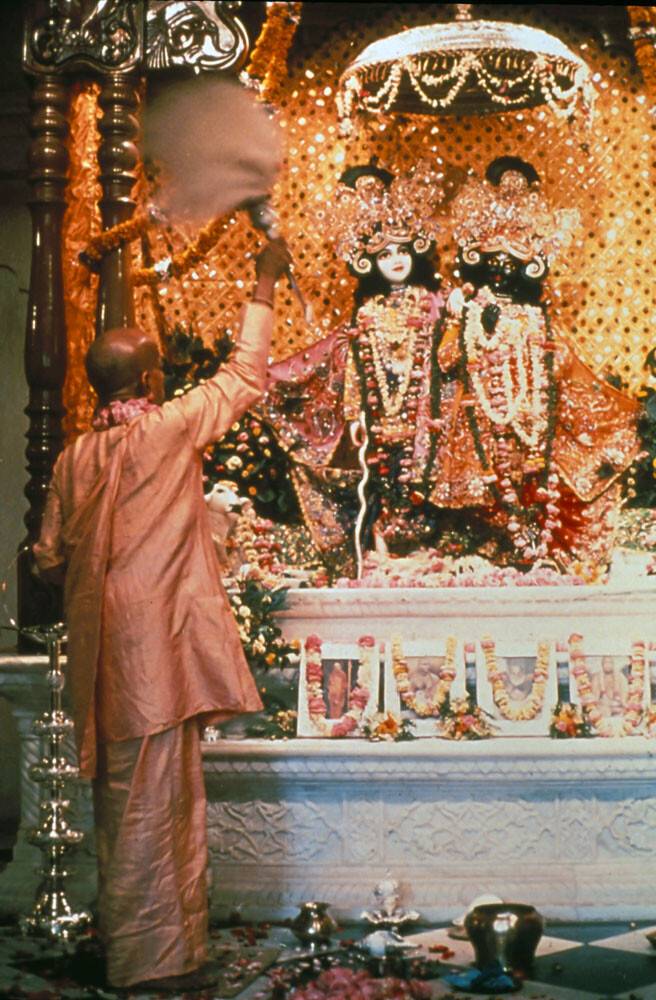
The Deity is non-different from Krishna
The Deities are Krishna Himself. Krishna is a person – this is the conclusion of all Vedas. Therefore Krishna has a form. This form is nirguna – non-material, but this does not mean that He is formless.
We cannot conceive of Krishna's form due to our materialism, so we tend to think that God is formless. But this is not Krishna's defect – it is our defect.
Bhaktivinoda Thakura "Jaiva Dharma"
"The form of the Deity, worshipped by Vaishnavas, is not a statue made by men. The form of the Supreme Personality of Godhead is all-powerful, eternal, and full of knowledge and bliss."
"When a devotee sees in his heart the spiritual form of the Supreme Personality of Godhead, he knows that it is the same form that has externally manifested as the Deity."
Archa vigraha
Archa vigraha (the form of the Lord's Deity designated for worship) is another form of expansion of the Supreme Lord. Only fools think that this form is material. Archa Vigraha descends at the invitation of acharyas and saintly teachers, and it acts exactly like Krishna Himself.
🔵 Yukta vairagya principle
Deity worship is possible because there are material concepts in our mind that can be applied. When looking at the Deity, we engage our eyes and mind. When eating prasadam – the tongue.
🌹 Narada Muni recommendation
In Kali-yuga, people are prone to constant contamination, so even Narada Muni recommends archanam – Deity worship, as a method to remain uncontaminated by sins.
Pastimes of the Deity
The Lord shows His mercy by appearing in a form made of material elements. Everyone should take the opportunity to visit the temple, meditate on the Deity, starting from His lotus feet and raising the vision towards His face.
🥛 Miracle of 1995
On September 23, 1995, Shiva and Ganesha Deities all over the world drank milk. Thousands of people saw this and fed milk to the Deities, receiving their mercy. This lasted for a whole week.
Deity Worship vs Idol Worship
✅ Deities
- Installed by an authorized person
- Worshipped according to authorized methods
- Form corresponds to scriptural descriptions
- Described in the Vedas
❌ Idols
- Made according to human imagination
- Worshipped by whimsical methods
- Form created according to fantasy
- Have no authorized basis
Forms of the Deity
Śrīmad Bhāgavatam 11.27.12
śaile dāru-mayī lauhe
lepyā lekhyā ca saikate
mano-mayī maṇi-mayī pratimāṣṭa-vidhā smṛtā
The Deity form of the Lord is said to appear in eight varieties: stone, wood, metal, earth, paint, sand, the mind, or jewels.
Five Forms of God
Karnika
Original form
Vyuha
Catur Vyuha
Vibhava
24 forms
Antaryamin
Paramatma
Archa
Deity
Service to Deities
Deity worship is available to everyone. Among the nine forms of devotional service, Deity worship is called archanam.
Puja
Rituals during which incense, fire, water, fan are offered to Deities
Arati
Various songs sung for the pleasure of Deities
Meditation
Offering prayers in the mind, meditating on the Deity's form
Prasadam
Eating Deities' prasadam and tasting charanamrita
Decoration
To sew clothes for Deities and decorate them
Cleaning
Cleaning the temple – another form of Deity worship
Words of Prabhupada
"One who cleans the temple and one who dresses the Deities gets the same benefit: śrī-vigrahārādhana-nitya-nānā-śṛṅgāra-tan-mandira-mārjanādau."
Rules of Worship
🌸 Wearing garlands
When a person decorates his body with tilaka and wears garlands offered to Krishna, there can be no question of him being bewitched by the spell of material energy.
💃 Dancing before the Deity
"If a person is in a joyful mood, if, while dancing before Me, he feels deep devotional ecstasy, all the reactions to his sins are burnt away."
🙏 Bowing to the Deity
A person who has even once respectfully bowed to the Deity will not return to this world, as he will go directly to Krishna's abode.
🚶 Circumambulate the temple
Worship of the Vishnu Deity by circumambulating Him can stop the repetition of birth and death in this material world.
Offenses in Deity Worship
The supplementary Vedic literatures provide a list which includes 32 offenses in serving the Lord. Here are some of the most important ones:
- To enter the temple with shoes on
- Not to offer obeisances to the Deity
- To enter without washing hands and feet
- To stretch one's legs before the Deity
- To lie down before the Deity
- To eat before the Deity
- To speak lies before the Deity
- To speak loudly before the Deity
- To quarrel before the Deity
- To punish someone before the Deity
- To curse before the Deity
- To pass air before the Deity
- To worship with less than one's means
- To eat food not offered to the Deity
- To sit with back to the Deity
- To praise oneself in front of the spiritual master
Gaudiya Vaishnava Deities
Sri Sri Gaura-Nitai
The most merciful forms of the Lord, who accept almost no offenses and liberally reward devotional service.
Radha-Krishna
Worship of these Deities requires many rituals and generally requires many brahmanas to worship them.
Krishna-Balarama
Krishna with His elder brother Balarama – popular Deities in Vrindavana.
Shalagrama Shila
The Lord in the form of a stone – especially sacred and easily worshipped at home.
Story about Jagannatha Deities
This story happened a few hundred years ago in Orissa. A young pujari loved the Deities very much, but once he overslept and didn't have time to tie his shikha. In a hurry, he placed a garland on Jagannatha, and just then the king entered.
The king asked for the garland as prasadam. The pujari gave him the garland, but a hair from the pujari's shikha was entangled in it. The king was disgusted and asked: "Where did this hair come from?". Frightened, the pujari lied: "From Jagannatha's head, my lord". The king said suspiciously: "If tomorrow morning there is no hair on Jagannatha's head, you will lose your own head".
In the morning, the pujari went to dress the Deities, trembling with fear, and was amazed – beautiful, real hair had grown on the heads of Jagannatha, Baladeva, and Subhadra! The king arrived, thought they were wigs, and tried to pull one off, but the hair was real. The king realized his mistake and fell at the pujari's feet.
The Lord broke the laws of nature to save His devoted servant.
Story about the Tax Collector
Tax collector Gadai Giri wanted to worship the Deity very much but could not go to Vrindavana. Krishna decided to come to him Himself. A sannyasi traveling with his Deity through Orissa received an instruction in a dream: "Take Me to that tax collector".
The sannyasi disobeyed. The next night Krishna "beat" him in a dream and said: "If you take Me to him, your wounds will heal when he touches you". In the morning, the sannyasi woke up all bruised. He crawled to Gadai Giri and offered him the Deity.
Gadai Giri initially refused, thinking he would not be able to worship properly, but when he touched the sannyasi and he was healed, he understood – Krishna really wants to be with him.
Varāha Purāṇa
"One who goes to Vrindavana and sees the Deity of Govindadeva is released from the court of Yamaraja and is allowed to enter the highest planetary system where the demigods reside."
Self-Check Questions
- Explain the difference between Deity worship and idol worship.
- Why do devotees worship Deities?
- Tell from what materials Deities can be made.
- List some offenses to avoid when worshipping Deities.
- List some rules for worshipping Deities.