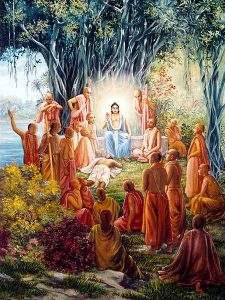
What is diksha?
Srila Jiva Gosvami explains diksha in "Bhakti Sandarbha":
divyaṁ jñānaṁ yato dadyāt kuryāt pāpasya saṅkṣayam
tasmād dīkṣeti sā proktā deśikais tattva-kovidaiḥ
"Diksha is the process by which one can awaken his transcendental knowledge and vanquish all reactions caused by sinful activity. A person expert in the study of the revealed scriptures knows this process as diksha."
— CC Madhya 15.108
Essence of Diksha
Diksha actually means initiation into the process of transcendental knowledge, through which a person becomes liberated from material contamination.
Two types of diksha
Bhagavata diksha (Harinama diksha)
First initiation – when the spiritual master empowers the disciple to chant the Hare Krishna mantra and gives the potential of this mantra.
In further spiritual life it also means the path of spontaneous attraction to Krishna (raga-marga).
Pancharatrika diksha (Mantra diksha)
Second initiation – during which the master empowers the disciple to chant the gopala mantra, kama gayatri etc.
Krishna mantra grants liberation (samsara mochana).
Shridhara Deva Gosvami on the connection between Nama and Mantra
"The Holy Name of Krishna is the larger circle. It extends from the highest to the lowest point. The mantra circle is smaller, within the larger one. The mantra cannot reach the lowest point. The Holy Name can reach even the lowest position. The mantra opens the door to liberation, and then the Holy Name carries us further. Everyone can receive the Name, but not everyone is fit for the mantra. Only after a person has reached a certain stage of development, can the mantra be given to him."
Important!
Harinama initiation is essential, because without it it is impossible to attain Krishna prema (love for Krishna). Second initiation without the first will also not yield its result, because without the first initiation the disciple will not have the qualification to chant the Krishna mantra (gayatri).
Necessity and meaning of initiation
The real connection with Krishna is established during initiation (diksha) by a bona fide spiritual master. This connection is established through the master, who is a direct representative of Krishna in the disciplic succession. Establishing a connection with the master is called initiation. without initiation from a bona fide master, a connection with Krishna never actually emerges.
yasyāprasādān na gatiḥ kuto 'pi
Diksha is an expression of the spiritual master's mercy, and without the master's mercy it is impossible to obtain Krishna's mercy.
Is it possible to receive Krishna's mercy without initiation?
Yes, one can. If one sincerely practices devotional service according to the rules and instructions of the shastras, tries to please Krishna and sincerely chants the Hare Krishna maha mantra, Krishna will grant him His mercy and send a bona fide spiritual master.
According to Vaishnava regulated principles, a devotee must be twice-initiated (dvija – twice-born) brahmana. This means that he must receive two initiations: Harinama initiation and brahmana initiation.
"Hari-bhakti-vilāsa" (2.6) quotes this instruction from "Visnu-yamala":
adīkṣitasya vāmoru kṛtaṁ sarvaṁ nirarthakam
paśu-yonim avāpnoti dīkṣā-virahito janaḥ
"Unless one is initiated by a bona fide spiritual master, all his devotional activities are useless. A person who is not properly initiated may again fall into animal species of life."
Goal of initiation
Sambandha
Initiation is the establishment of a relationship with Krishna through a spiritual master.
Abhideya
It provides the opportunity to serve Krishna once the relationship is established.
Prayojana
The ultimate goal is to return to Krishna in the spiritual world.
Initiation means a beginning. But it continues further after the initiation ceremony. Initiation is not the goal that a devotee must strive for. Initiation is not a matter of prestige. Initiation is for those who want to sincerely continue further on the path of spiritual progress.
The spiritual master delivers his disciple from the clutches of Maya by initiating him into the chanting of the Hare Krishna mantra. In this way, a person can revive his sleeping consciousness by chanting this mantra. Later, the second initiation enables the devotee to chant the gayatri mantra, which reveals the spiritual form of Krishna in the spiritual world.
Second birth
Diksha is called a second birth, and one who has received diksha is called twice-born – dvija. At the time of the second birth, a person receives the spiritual master as his father and the Vedas as his mother.
In Sanskrit, birds are also called dvija – twice-born: first born in an egg, then born from it. Having been born a second time, we can fly high in the sky of our spiritual expectations. This is the magic of diksha and shiksha.
The initiation by a spiritual master changes the disciple's life. Narada Muni, in his previous life, after associating with sages, changed vividly. In the same way, initiation and association with the master changes a person's life toward spiritual understanding.
If the disciple is initiated and follows the principles, he quickly becomes liberated from the contamination of material life. The initiated disciple performs the bhajana kriya process – daily chanting sixteen rounds of the maha-mantra, abstaining from meat, intoxicants, gambling, and illicit sex.
Chaitanya Charitamrita on the power of mantras
kṛṣṇa-mantra haite habe saṁsāra-mocana
kṛṣṇa-nāma haite pābe kṛṣṇera caraṇa
"By chanting the Krishna mantra one will be liberated from samsara (the cycle of birth and death). By chanting Krishna nama he will reach the feet of Krishna."
Can one have multiple diksha gurus?
Why can a disciple have many shiksha gurus and only one diksha guru? Rupa Gosvami begins listing the elements of sadhana bhakti in this order:
- Accepting the shelter of a spiritual master
- Receiving initiation from him
- Receiving shiksha (instructions) from him
Diksha guru
- Can only be one
- Manifestation of the Madana-Mohana Deity
- Gives sambandha-jnana (knowledge of relationship)
- Transmits the mantra – the seed
- Single function: to grant the mantra
Shiksha guru
- Can be many
- Manifestation of the Govindadeva Deity
- Gives abhideya-jnana (knowledge of activities)
- Waters the seed with instructions
- Multifaceted function: gives directions
The example of Thakura Bhaktivinoda
In the classical case, the diksha guru is also the shiksha guru. However, it is possible that the shiksha guru will be more important in the disciple's spiritual life than the diksha guru. An example is the life of Thakura Bhaktivinoda. His shiksha guru – Jagannatha dasa Babaji played a significantly more important role than his diksha guru – Bipina Bihari Goswami.
Is initiation only a formal process?
In a sense, initiation is the formalization of the relationship between the guru and the disciple, recognizing that something is already happening between them. In the same way, marriage formalizes relationships that existed before. However, in the formal ceremony, what is very important also happens: the disciple takes vows, and the master transmits the mantra to him.
Power of the mantra
Srila Shridhara Deva Gosvami speaks: "Just as the outer shell of a homeopathic pill cannot show what medicine is inside, so it is with the sound – with the name of Krishna. The one who gives this name, his will lies in the sound. Thus, Krishna from the lips of a saint and Krishna from the lips of an ordinary person is not the same."
Does diksha dispel all doubts?
Important instructions (shiksha) follow diksha and thus doubts are dispelled. But doubts are dispelled more than shiksha by experience. We want a tangible spiritual experience arising from applying the shiksha we received from teachers in spiritual practice.
Spiritual practice is not a purely rational act. Although it is rational to recommend engaging in spiritual practice, the act itself is trans-rational. Thus in it, as in the granted mantra, lies magic. The magic of the mantra hiddenly conceals the experience of this mantra transmitted by the guru. This is an act of sharing and love, motivated only by sincere compassion and nothing else.
Requirements for initiation
Essential requirements
A person cannot receive initiation until he renounces the principles of material life and follows the regulating principles. Vaishnavas never grant initiation to persons who are unwilling or not inclined to give up sinful things.
⚠️ The teacher is not a businessman who needs many followers. He is a representative of God.
The disciple takes a vow at the time of initiation. No one forces the disciple to take vows if he feels unprepared to follow all the rules. However, if a person breaks his vow, he is not worthy of attention either in the eyes of Krishna or the Vaishnavas.
Initiation as a contract
Initiation is a contract signed by both sides: the disciple promises to follow the regulating principles, chant the mantra, and carry out the master's instructions. The master promises to lead the disciple to Krishna. If one side does not keep their commitments, the other side is no longer obliged to keep theirs.
ISKCON initiation process
- First, students must wait at least 6 months – attending arati and lectures, following the regulating principles.
- When sufficiently prepared, local authorities can recommend them to a spiritual master, who allows the student to chant the pranama mantra.
- After at least one year, the candidate is again recommended to the spiritual master, who grants first initiation.
- Later, strictly following the rules, the disciple can receive second initiation and the sacred thread.
Mutual testing of spiritual master and disciple
Before establishing a mutual connection, the disciple and the master must carefully analyze each other. The disciple must be convinced that he can surrender to this person. One should not accept a master suddenly or out of fanaticism, as it is very dangerous. If the master is not of a sufficiently high level, the disciple will start to see faults in him and offend him.
The master must also observe the disciple to see if he is ready for initiation. Otherwise, the disciple will not carry out the master's instructions and will suffer for it.
During initiation, the spiritual master takes on the disciple's karma
Guru assumes the disciple's karma
Chaitanya Mahaprabhu forbade teachers to accept more than twelve disciples; otherwise, he might not be able to withstand the disciples' karma.
When a teacher takes upon himself the sinful reactions of his disciples, the results of his own virtuous deeds diminish. Since the teacher is not Krishna himself, he sometimes has to suffer.
⚠️ When disciples perform sinful acts, the teacher sees bad dreams. Therefore, disciples should not cause trouble for their teacher.
Chaitanya Mahaprabhu said: bahu shishya na kariba – do not accept many disciples.
Self-Check Questions
- Briefly describe what diksha is.
- List the essential requirements for first initiation.
- Why is testing of the master and disciple necessary before initiation?
- Why did Chaitanya Mahaprabhu not allow accepting more than twelve disciples?