Knowledge
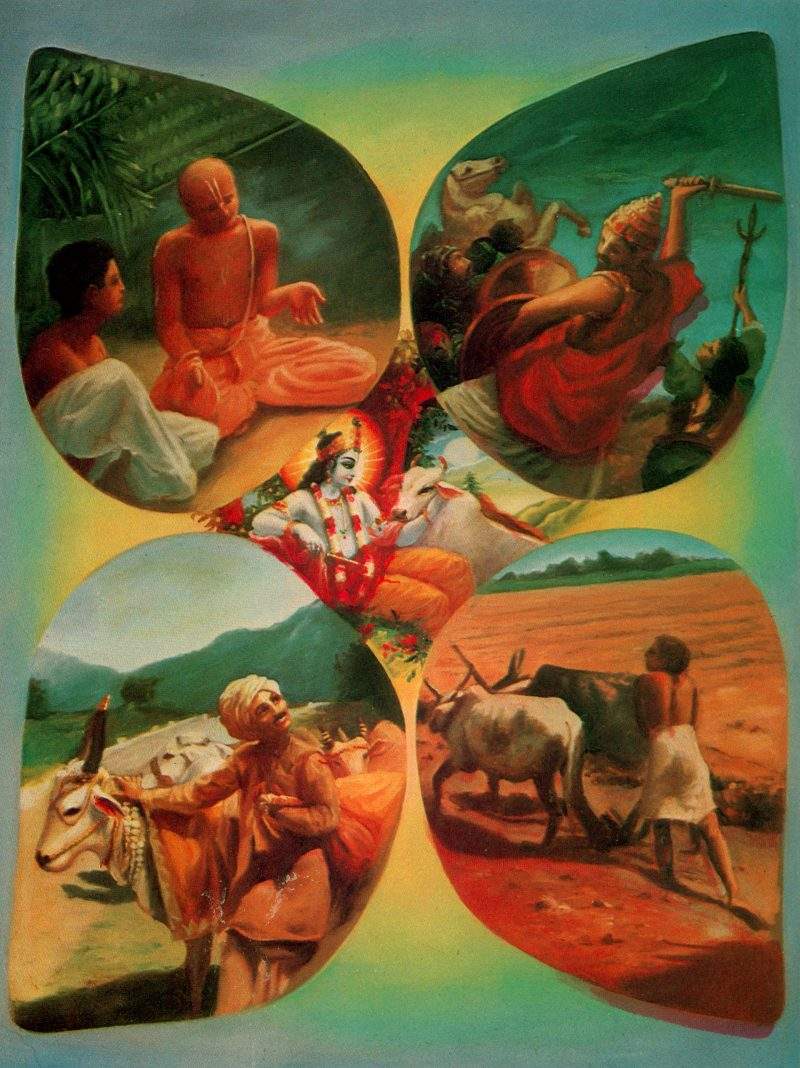
All branches of Hinduism are based on the Vedas – scientific knowledge about God, the soul, and the world. The word "Veda" comes from the Sanskrit verb vid – to know. "Veda" means knowledge. By carefully studying the Vedas, we will see that they are directed toward the search for and investigation of one cause that underlies all existence. That which is the cause of all existence or reality can be called the Absolute Reality or the Absolute Truth.
(Muṇḍaka Upaniṣad 1.3) – By knowing the Absolute Truth, everything is automatically known.
Isn't this the knowledge that everyone seeks?
Unfortunately, not all knowledge is self-evident to all people. Depending on the quality of consciousness, the quality of existence, deeper or more superficial levels of being or reality will be revealed to a person. This is natural. Since the Vedas also speak about very high levels of reality, not every person can understand this. When faced with the unknown, we always have two choices:
- Reject it, denying the fact;
- Accept what we don't understand through faith.
In other words, what for one person who has purified their existence will be direct experience, for another person who has not purified their existence, will be a matter of faith. In any case, we must agree that a person cannot know that which they do not believe in. Any knowledge is made possible only by faith.
Having said this, questions of primary importance arise:
What is existence and what is faith?
Why faith is important is illustrated by this phrase:
"Sanat-kumāra said: 'When a person develops faith (śraddhā), they can think about things and understand them, but without faith no one can do this. Indeed, only a person who has faith can contemplate anything. Therefore you should ask very specifically about faith.' Nārada said: 'O teacher, I want to know specifically about this faith.'"
— Chāndogya Upaniṣad (7.19.1)
The deepest discussion about faith and its relationship with existence is presented in the "Bhagavad-gītā" 17.3 verse:
sattvānurūpā sarvasya
śraddhā bhavati bhārata
śraddhā-mayo 'yaṁ puruṣo
yo yac-chraddhaḥ sa eva saḥ
A literal translation of the verse would be: "O descendant of Bharata, faith takes the form that arises from existence. This puruṣa (living entity in the material world) is made of faith. Whatever they direct their faith toward (whatever is the object of their faith), that alone they are."
A deeper analysis of the verse reveals three objects worth discussing:
- Puruṣa – the living entity
- Sattva – existence
- Śraddhā – faith
Puruṣa – the person
Krishna in the "Bhagavad-gītā" largely uses the terminology of sāṅkhya, which investigates tattva. Tattva is reality, or aspects of reality that can be distinguished or specifically indicated. In philosophical literature, the word tattva is translated as ontological truth. Ontology is the science that examines being and existence. Despite the fact that Absolute Reality can be called God, Spirit, Brahman, and all these names undoubtedly have one and the same nature – spiritual, nevertheless the Vedas state that this Absolute Reality is not homogeneous like, for example, radiance, love, goodness, etc. Absolute Reality consists of aspects that can be distinguished or indicated within It. This is called by the word tattva.
The teaching of sāṅkhya, whose purpose is precisely to enumerate or count (Sanskrit: saṅkhyā – means to count, enumerate) all aspects of reality. The sāṅkhya sages counted that there are two such aspects of reality, not counting God – puruṣa and prakṛti.
Puruṣa in Sanskrit means "man" or "enjoyer". Prakṛti means "nature" (the world) or "the feminine principle". In "Bhagavad-gītā" 7.5, Krishna says that Puruṣa inhabits material nature (Prakṛti) and uses it to satisfy their needs. The words Puruṣa and Prakṛti are used in the singular as generic terms indicating two realities of the world.
However, in "Bhagavad-gītā" 15.16, Krishna says that in this world (loke) there are two Puruṣas (again in the generic sense. This does not mean there are only two living entities in the universe). One Puruṣa – Person is kṣaraḥ – perishable or falling, i.e., one who fails to achieve their goals. This kṣaraḥ is all created (literally – becoming or transmigrating) entities (sarvāṇi bhūtāni).
The other Puruṣa is akṣaraḥ – imperishable, not falling, or one who succeeds in achieving their goals. The existence of this Puruṣa – Person – is spiritual being, which is at the pinnacle of all being (kūṭa-sthaḥ) or in unity with the Absolute Truth. In other words, Krishna divides all living entities into two categories:
- Conditioned souls, who are forced to perform activities and live with imposed desires;
- Free or liberated souls, whose desires are the expression of their free existence, and who exist in a loving union with the Supreme Being – God.
God in "Bhagavad-gītā" 15.17 is defined as yet another Puruṣa (already the third), who differs from both conditioned and liberated living entities. His nature is different (anyaḥ) – uttamaḥ (supreme). He enters these worlds and sustains them Himself.
Important: The Constitution of the Person
The Vedas state that the Puruṣa – Person's – svarūpa (true nature) is composed of three elements:
- Sat – eternity
- Cit – knowledge or awareness
- Ānanda – bliss or causeless joy
The living entity, puruṣa, upon entering the material world acquires a transformed nature. Its true nature (siddha-svarūpa) becomes hidden, and the acquired nature is called nisarga. In this nisarga – acquired nature, all the original elements of the spiritual soul (sat, cit, ānanda) are replaced by their distorted analogues:
- Bhava – becoming (as opposed to being);
- Avidyā – lack of knowledge;
- Nirānanda – lack of bliss or causeless joy.
In the material world we can exist only by constantly changing bodies, being born and dying. Perception and knowledge are not inherent to material nature; we must seek them by learning and developing thought, constantly trying to remember what is quickly forgotten. Here we also do not experience joy without cause. Any joy must have its external source, and when it is exhausted, the awareness of suffering comes.
In the above-mentioned verse about faith (BG 17.3), Krishna mentions puruṣa – the person living in material existence. In their acquired nature, knowledge is replaced by faith (śraddhā). Therefore Krishna says that all conditioned entities are made of faith.
Sattva – being, existence
But faith is one of three elements of the conditioned soul. Another no less important element for both the soul and its faith is sattva. The root of the Sanskrit word sattva is sat, which means that which is real, which exists, which is eternal.
In "Bhagavad-gītā" 2.15, Krishna sets forth the fundamental principle of Vedic ontology (the science of being):
nāsato vidyate bhāvo
nābhāvo vidyate sataḥ
ubhayor api dṛṣṭo 'ntas
tv anayos tattva-darśibhiḥ
Literal translation: "That which does not exist (asat) is changeable. That which is unchangeable is called existing (sat). Such a conclusion has indeed been reached by the seers of truth (those who can distinguish tattvas), observing the essence of both."
In other words, that which is changeable cannot be called existing, because it constantly changes its being from one to another. Only that which is unchangeable (the spiritual soul) can be called existing, because it does not undergo changes and is eternal. Eternal is that which does not change. This means that which exists is eternal, and that which does not exist is temporary. It should be noted that asat – non-existence – does not refer to non-being in the Western sense, but rather to the temporality of becoming or real experience in the material world.
In "Bhagavad-gītā," existence is synonymous with eternity. That which exists is called by the word sattā. And the being of objects existing in reality is called sattva or śuddha sattva (pure being). It should be noted that material objects or inanimate matter do not have sattva – signs of being and are called asat.
When the nature of living entities (siddha svarūpa) is transformed under the influence of Māyā, their existence śuddha sattva takes on a distorted form, manifesting as becoming (bhava). This does not mean that the soul does not exist in the material world. For the soul to exist in the material world, it needs conditions that are fulfilled by material nature. Material nature has three functions (dharmas), which are called:
- Rajas (passion) – provides the beginning (birth);
- Sattva (goodness) – maintains being in the body;
- Tamas (ignorance) – ends being (death).
In the verse about faith, Krishna, using the word sattva – being, is not speaking about pure being (śuddha sattva), but about māyika sattva (illusory being), governed by these modes (guṇas) of nature.
Krishna says that faith takes such a form as our material being is. A person's ability to know reality depends on the quality of their being. A person governed by sattva guṇa (goodness) will choose to believe in things that promote existence itself and its purification. From this comes the meaning of the word sattva guṇa – the quality of goodness. Virtuous or good is that which promotes existence itself (sattva).
Śraddhā – faith
In the West, the question "What is faith" is hardly examined scientifically, although it should be. Like consciousness, faith is inseparable from every person, although it is said that there are also atheists. In "Bhagavad-gītā" 17.3 it is said that faith forms the foundation of our personality.
In Sanskrit, śraddhā consists of śrat and dhā. Śrat means "heart", "trust", "loyalty". Dhā means "to put", "to place". Literally śraddhā means "to put the heart", to direct one's heart, one's trust in some direction.
Faith as a Scale of Values
Why do we want to trust some things while doubting others? The answer: because we value some things more than others. Every person has their own value system. In the context of Vedic psychology, the word śraddhā has only this meaning – a scale of values. Faith is related not to otherworldly things, but to the very foundation of our being – consciousness or awareness. Faith manifests every moment, directing consciousness toward one object or another.
Faith is an inseparable tendency of the personality (puruṣa) to assign value to objects and phenomena. Value means the meaningfulness of an object, and in the material context primarily its usefulness to our being or everyday life.
Then, who is an atheist? One who assigns the greatest value to inanimate nature, because they associate their being with it, satisfy their needs in it, and experience pleasure from it. From this perspective, a person who believes in God is one who in their scale of values assigns the greatest value to God, because in Him they see the foundation of their being, in Him they find the fulfillment of the soul's needs, and with Him they associate their being's joys and pleasures.
Dimensions of Values
When making decisions, we rely on values that exist in five dimensions:
- Sensory values. This dimension includes sensual pleasures and matters of taste.
- Intuitive values. Here we see conscience, judgments (this is good, that is bad), trust and intuition. This also includes the sense of guilt.
- Rational values. We decide based on what we learned from authorities: teachers, parents, scriptures, laws, rules of morality and ethics. We rely on logic, distinguishing good from evil, correcting our sensory and intuitive values.
- Spiritual (idealistic) values. The spirit wants to be freed from evil, sin, material slavery. Senses, intuition, and even the laws of rationality tremble before the desire to overcome evil, because this can mean a death sentence.
- Values of love and devotion. For the sake of love, a person can renounce sensory, intuitive, logical values and even forget the aspiration for liberation, which is so dear to the soul.
The scale of values, which depends on the quality of existence, also determines one or another field of knowledge as important or significant. After all, only faith and nothing else makes us think that knowledge reveals truth. A scientist whose being is purest will seek to investigate the most difficult to investigate, but at the same time the most significant realm of consciousness.
Self-Check Questions
- What does the word Veda mean?
- What is a Person? Can there be different types of Person, and if so, what are they?
- Of what three elements are spiritual souls composed?
- Describe the essence of Vedic ontology based on the verse from Bhagavad-gītā 2.15.
- What is existence and what does it depend on?
- Explain what faith is?
- How is faith related to existence?
- What are the basic dimensions of values?