The Story of Lost Money
If one person finds money, he takes it for himself; another thinks he is honest and leaves it lying there, thinking it is not his; and a third takes it, finds the owner, and returns the money to him. These three paths are like that. Karmis take everything for themselves. Jñānīs think that everything is an illusion, and we ourselves are an illusion—nothing belongs to us. Bhaktas realize that everything belongs to Krishna, so they use everything in His service. This is a very clear example showing the advantage of bhakti.
BG 6.47 states:
yoginām api sarveṣāṁ
mad-gatenāntar-ātmanā
śraddhāvān bhajate yo māṁ
sa me yuktatamo mataḥ
"And of all yogīs, the one with great faith who always abides in Me, thinks of Me within himself, and renders transcendental loving service to Me—he is the most intimately united with Me in yoga and is the highest of all. That is My opinion."
KARMA KANDA
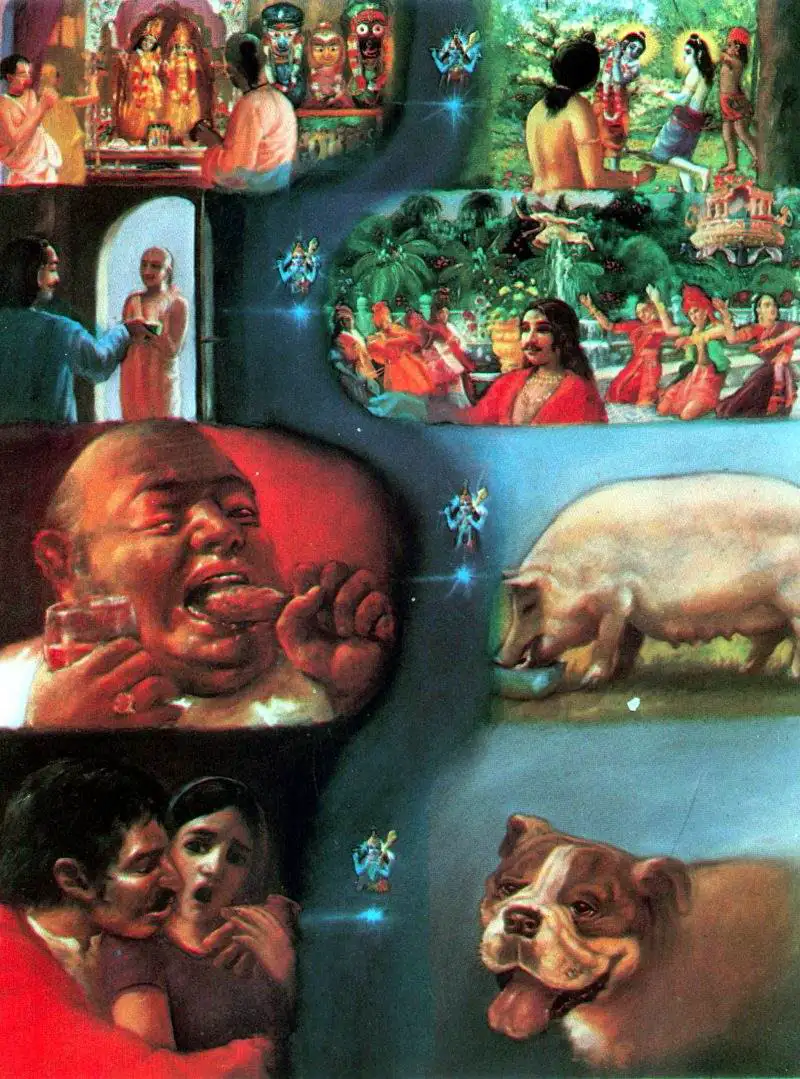 Sources: "The Nectar of Devotion", Chapter 5
Karma means activity or the results of activity. Every person works hard to achieve a result. Everyone works to live better.
Karma-kanda refers to the section of the Vedas that describes rituals and means to reach heavenly planets, to be born into a wealthy family, or to have virtuous descendants. Thus, karma-kanda describes how a person can improve their living conditions in the material world. The rules of karma-kanda are very difficult and strict, therefore those who follow this path are compared to fools. They seek things that have no great value and work hard to get a meager result. All conditioned souls who madly pursue sense pleasures and do not know that they will never emerge from the mire of matter in this way, earn only one reward for their efforts—an endless cycle of births and deaths. In the fifth canto of the Srimad-Bhagavatam, Rishabhadeva clearly says to his sons: "People engaged in karmic activity are born and die again and again, and until they experience love for Vāsudeva, there can be no talk of their liberation from the strict laws of material nature." In Bhagavad-Gita 4.12, Krishna says:
kāṅkṣantaḥ karmaṇāṁ siddhiṁ
yajanta iha devatāḥ
kṣipraṁ hi mānuṣe loke
siddhir bhavati karma-jā
"Men in this world desire success in fruitive activities, and therefore they worship the demigods. Quickly, of course, men get results from fruitive work in this world."
However, they must realize that Krishna gives those results, and that the demigods are only Krishna's authorized personas who have no independent existence. The result of such worship is temporary and limited. A person, by worshipping demigods, cannot achieve liberation from the clutches of matter, since even the highest demigods are also subject to birth and death. Krishna calls those who seek material prosperity "men of small intelligence." BG 7.23 states:
antavat tu phalaṁ teṣāṁ
tad bhavaty alpa-medhasām
devān deva-yajo yānti
mad-bhaktā yānti mām api
"Men of small intelligence worship the demigods, and their fruits are limited and temporary. Those who worship the demigods go to the planets of the demigods, but My devotees ultimately reach My supreme planet."
The demigods themselves cannot give any blessings to people if Krishna Himself does not sanction it. As Paramātma, He is even in the hearts of the demigods and gives them the opportunity to satisfy the desires of the worshipper. Therefore, it is said that the goal of all sacrificial offerings is Vishnu. He is the mediator and the ultimate maintainer. He alone provides what is needed for all living beings (eko bahūnāṁ yo vidadhāti kāmān).
The limitation of karma-kanda is that this path cannot provide liberation. It is a materialistic path for foolish and small-minded people. However, the Vedas do not reject this path because such people exist. This path is given to them so that they learn to obey the authority of the Vedas. A person who sees how his desires are fulfilled gains faith in the Vedas. Then, after some time, he can understand other Vedic instructions that speak of transcendence. A person who has faith in the Vedas understands that material results are always limited and cannot satisfy the soul. Then the person transitions to karma-yoga, which is higher than karma-kanda.
Karma-yoga
This is activity with the renunciation of results. Every person has a job they like. They cannot simply give up this activity and do only what is required of them. Therefore, in the initial stage on the path to transcendence, the Vedas do not require giving up the activity itself, because the cause of suffering and attachment is not in the activity but in the result. Therefore, one who wants to achieve yoga must learn to renounce the results of activities. Every activity creates two results: direct and indirect.
Direct result
The product created by our activities: for a teacher—the education of students, for a manager—the productivity of the office, for a businessman—the goods, and for a worker—the product.
Indirect result
The salary we receive for our work. Mostly this will be monetary profit or other goods. The compensation for a business owner will be his company's profit, for a worker—his wages.
One must learn to sacrifice both of these results to God or others. First, by creating value, a person thinks he is doing it for God, not for himself. This is the first condition of karma-yoga. A teacher thinks that the students' education is for the glory of God. A manager thinks that his company works for the glory of God, and so on.
Second, he must learn to give the money he earns to others. Krishna says in the Bhagavad-gita (18.5):
yajña-dāna-tapaḥ-karma
na tyājyaṁ kāryam eva tat
yajño dānaṁ tapaś caiva
pāvanāni manīṣiṇām
"Acts of sacrifice, charity and penance are not to be given up; they must be performed. Indeed, sacrifice, charity and penance purify even the great souls."
All three of these forms of activity constitute the content of karma-yoga. Sacrifice is what we give to someone higher than ourselves, i.e., to God. Charity is what we give to someone lower than ourselves, i.e., to a poor, unhappy person. Penance is what we take away from ourselves by giving it up entirely. The greatest penance is not self-torture, but the renunciation of material pleasures provided to us by activities, position, and money.
Simple karma-yoga, where a person gives money to charity, feeding people, building hospitals, etc., cannot be called Krishna consciousness. But when a person begins to sacrifice the results of his activities to a Krishna temple or to holy persons, then his activities approach bhakti-yoga. Then it is called karma-yoga—activity in Krishna consciousness. This is the introductory stage to pure Krishna consciousness.
Karma-yoga is reflected by a verse from the Bhagavad-gita 9.27
yat karoṣi yad aśnāsi
yaj juhoṣi dadāsi yat
yat tapasyasi kaunteya
tat kuruṣva mad-arpaṇam
"Whatever you do, whatever you eat, whatever you offer or give away, and whatever austerities you perform—do that, O son of Kuntī, as an offering to Me."
JÑĀNA KANDA
Jñāna joga (it is said: gyana yoga) – knowledge for the sake of truth. This is better than karma kanda , but philosophical knowledge alone or meditation, self-renunciation, suppression of the senses etc. are not the highest form of yoga. Jñāna joga's result is the realization of the impersonal Brahman. This means a person can realize the Absolute Truth in an impersonal form and be liberated from the cycle of birth and death. However, above the Brahman aspect is the Paramatma aspect and the Bhagavan aspect, which remain beyond jñānī's realization. Jñānīs use the mind and intellect, employing the neti neti principle – "not this brahman, not this brahman". In this way, rejecting all that is material, they strive to realize what is spiritual. In fact, they cannot realize what Brahman is. They can only understand what He is not.
Jñāna joga claims that a person can realize the Absolute Truth by their own efforts. This he can do by controlling the mind and senses. Brahman can be known by knowing oneself. The impersonal conception Jñāna joga lies exactly in the assumption that a person can know himself, his true self, and then, when he has known himself, he feels as if everything else is already known to him. This Self is only a material designation. The only true thing is the non-dual Brahman . All living beings are this Brahman , which has no individuality. It is the sum total of all souls and is integral, not composed of parts. Such a conception is imperfect because it is based on the assumption that everything can be known by the effort of will. It is not considered that trying to know oneself, one's true self is attempted through the mind and intellect – methods of a lower level.
Krishna says (BG 12.5):
kleśo ’dhikataras teṣām
avyaktāsakta-cetasām
avyaktā hi gatir duḥkhaṁ
dehavadbhir avāpyate
"For those whose minds are attached to the unmanifested, impersonal feature of the Supreme, advancement is very troublesome. To make progress in that discipline is always difficult for those who are embodied."
Therefore, it is said that only a rare jñānī comes to devotional service to Krishna.
BG 7.19 says:
bahūnāṁ janmanām ante
jñānavān māṁ prapadyate
vāsudevaḥ sarvam iti
sa mahātmā su-durlabhaḥ
"After many births and deaths, he who is actually in knowledge surrenders unto Me, knowing Me to be the cause of all causes and all that is. Such a great soul is very rare."
In this verse, it is stated that true knowledge manifests precisely in the fact that we understand that Brahman also is not an independent existence. Brahman is only the effulgence of the Supreme Lord's body. That is, the Lord is the source of the existence of all living beings.
Jñāna-yoga in Krishna consciousness
Viśvanātha Čakravarti Thākura says that jñāna is of three types:
Tad padārtha jñāna
Knowledge of God.
Tvam padārtha jñāna
Knowledge of the individual living being.
Jīva brahma aikya jñāna
Knowledge of the oneness between the individual being and God (to be avoided).
The first two forms of jñāna are favorable to Krishna consciousness; they actually constitute the content of sambandha jñāna, which is essential and necessary for the practice of Krishna consciousness.
The third type of jñāna is alien to the soul's nature and distracts it from its highest goal—love for God. Devotees should avoid it in every way.
In Krishna consciousness, jñāna manifests when we strive to realize Krishna, to know Him. In this case, the word jñāna means knowledge, realization. Such realization is to be encouraged, as it means we must inquire from a higher source of knowledge, a spiritual master, so that he may reveal the truth to us. BG 4.34 says:
tad viddhi praṇipātena
paripraśnena sevayā
upadekṣyanti te jñānaṁ
jñāninas tattva-darśinaḥ
"Just try to learn the truth by approaching a spiritual master. Inquire from him submissively and render service unto him. The self-realized souls can impart knowledge unto you because they have seen the truth."
Jñānīs realize themselves as Brahman . This is not the self-realization that Krishna speaks of in this verse. In other words, it is incomplete self-realization. One who has fully realized himself understands that he is a part of Krishna.
Therefore, the path of jñāna-yoga differs from bhakti-yoga in that in the first case we try to reach the Absolute Truth by our own efforts, and the spiritual master is needed only to show us the direction. In the second case, we realize that we will not understand the truth by our own efforts, therefore we pray to the Supreme that He reveals Himself to us. An example of such an attitude is the person who prays in Śrī Īśopaniṣad, mantra 15:
hiraṇmayena pātreṇa
satyasyāpihitaṁ mukham
tat tvaṁ pūṣann apāvṛṇu
satya-dharmāya dṛṣṭaye
"O my Lord, sustainer of all that lives, Your real face is covered by Your dazzling effulgence. Kindly remove that covering and exhibit Yourself to Your pure devotee."
In the case of this prayer, we see a desire to know the Lord, to see Him, and this is called jñāna, but it does not belong to jñāna-kanda, because we do it with devotion and the goal is to serve the Lord.
BG. 7.17 Krishna says who the real jñānī is:
teṣāṁ jñānī nitya-yukta
eka-bhaktir viśiṣyate
priyo hi jñānino ’tyartham
ahaṁ sa ca mama priyaḥ
"Of these, the wise one who is in full knowledge in union with Me through pure devotional service is the best. For I am very dear to him, and he is dear to Me."
Krishna Himself provides knowledge—jñāna—to His devotee, so that this devotee does not need to specially waste time studying to realize the Absolute Truth. In BG 10.10, Krishna says:
teṣāṁ satata-yuktānāṁ
bhajatāṁ prīti-pūrvakam
dadāmi buddhi-yogaṁ taṁ
yena mām upayānti te
"To those who are constantly devoted to serving Me with love, I give the understanding by which they can come to Me."
Krishna shows special mercy to His devotees and, being the shining lamp of knowledge within their hearts, dispels the darkness of ignorance.
UPASANA KANDA – Worship
Krishna consciousness is described in Srila Rupa Gosvami's "Bhakti Rasamrita Sindhu":
anyābhilāṣitā-śūnyaṁ
jñāna-karmādy-anāvṛtam
ānukūlyena kṛṣṇānu-
śīlanaṁ bhaktir uttamā
Uttama-bhakti or pure devotional service—is constant activity for Krishna's sake, which:
For Krishna's pleasure
The activity must please Him; this is the main criterion.
Our satisfaction
Causes us satisfaction because we see how Krishna appreciates it.
Without motives
We engage in it without any other material goals (bhukti or mukti).
Upasana-kanda is higher than karma and jñāna. However, the peak of upasana-kanda is devotional service to the Lord.
BG 8.28 states:
vedeṣu yajñeṣu tapaḥsu caiva
dāneṣu yat puṇya-phalaṁ pradiṣṭam
atyeti tat sarvam ida m viditvā
yogī paraṁ sthānam upaiti cādyam
"A person who accepts the path of devotional service is not bereft of the results derived from studying the Vedas, performing sacrifices, undergoing austerities, giving charity or pursuing philosophical and fruitive activities. Simply by performing devotional service, he attains all these, and at the end he reaches the supreme eternal abode."
Quote from "Jaiva Dharma"
Below we present an important excerpt from Bhaktivinoda Thākura's book "Jaiva Dharma", Chapter 12, discussing the differences between karma-kānda, jñāna-kānda, and bhakti-kānda:
Bābājī: : Anyone who studies nyāya śāstra and then asks about sādhya and sādhana is truly blessed in this world, because the primary goal of nyāya-śāstra is to establish axiomatic truths using logical analysis. It is a waste of time to study nyāya-śāstra only to learn how to engage in dry arguments and debates. If a person does so, his study of logic has produced an illogical result; his work is in vain and he has wasted his life.
Sādhya means the truth (tattva) that is achievable by engaging in appropriate practice. Practice is called sādhana , and it consists of the means a person takes to achieve the sādhya (goal). Those who are bound by māyā perceive various objects as the ultimate goal of life, depending on their personal tendencies and qualification. In reality, however, there is only one supreme goal.
There are three goals a person can pursue, and each individual will choose one goal or another according to their tendencies or adhikāra (capacity). These three goals are bhukti (material satisfaction), mukti (liberation), and bhakti (devotional service).
Bhukti
Material satisfaction
Those who are fascinated by material activities and those who are controlled by the desire for material pleasures. The Shastras are compared to the Kamadhenu cow, fulfilling these desires through Karma-kanda.
Mukti
Liberation
The desire to be liberated from suffering and the cycle of karma. The aim is to end material existence, but this is often only an intermediate station (Jñāna-kanda).
Bhakti
Devotional service
The ultimate goal (Sādhya). It is the eternal activity and perfection of the soul, transcending both Bhukti and Mukti. It is both the path and the goal.
There exist various types of sense pleasures that a person can enjoy in their state after death, and these pleasures are called āmutrika-sukha (pleasures related to the next life). For example, the pleasures of the heavenly spheres, including life in Svarga (higher planets) or Indraloka (Indra's planet) and watching the dancing of heavenly damsels of loose behavior called apsaras, drinking the nectar of immortality, smelling fragrant flowers and enjoying the beauty of the nandana-kānana gardens, seeing the beauty of Indrapura, listening to the melodious songs of the gandharvas, and associating with the heavenly maidens called vidyādharīs.
Above Indraloka follow Maharloka, Janaloka, Tapoloka and finally Brahmaloka, the highest planet in the material universe. The Shastras provide fewer descriptions of Maharloka and Janaloka than of the heavenly pleasures in Indraloka, and even fewer descriptions of Tapoloka and Brahmaloka. On the contrary, sense pleasures on this earth planet Bhūrloka are particularly gross. The rule is this: the higher the planetary system, the more subtle are the senses and their objects. This is the only difference between these kingdoms; otherwise, the happiness achievable on all these planets is solely sense pleasure and there is no happiness beyond them. Spiritual happiness (cit-sukha) is not achievable on these planets, as the happiness found in those places is related to the subtle body, which consists of mind, intellect, and ego, and which only slightly resembles pure consciousness. Enjoyment of all these types of pleasures is called bhukti, and the sādhana of the jīvas lost in the cycle of karma consists of the activities they perform to realize their bhukti aspirations. In the Yajur Veda (2.5.5) it is said:
svarga-kāmo ’śvamedham yajeta
"Those who desire to reach the heavenly planets must perform the aśvamedha-yajña."
The Shastras describe many different types of sādhana to achieve bhukti, among them certain fire sacrifices called agniṣṭoma, offerings to a certain class of devatās (demigods), digging wells, building temples, doing good deeds for others, and ceremonies performed on new and full moon days. Bhukti is the sought-after goal for those who desire material satisfaction.
Some of those who are oppressed by the sufferings of material existence consider the fourteen planetary systems, which are abodes of material pleasures, as worthless. Therefore, these people desire to be liberated from the cycle of karma. They consider that mukti is the only sādhya and that bhukti is simply shackles. Such people say: "Those whose inclination for material pleasures has not yet faded can achieve their bhukti goal by following karma-kānda." However, the Bhagavad-gita (9.21) states:
kṣīṇe puṇye martya-lokaṁ viśanti
"When the results of their pious activities are exhausted, they again enter the planets of mortals."
"This śloka clearly and irrefutably states that bhukti is perishing and non-eternal. Everything that is subject to decay is material, not spiritual. A person must engage in sādhana only seeking an eternal goal. Mukti is eternal, therefore it certainly must be sādhana for all jīvas. Mukti can be achieved through four types of sādhana. These types are: to distinguish between eternal and temporary objects; to renounce the enjoyment of the results of one's work in this and the next world; to develop six qualities such as control of mind and senses; and also to cultivate the desire for liberation. These four forms of activity are called true sādhana."
Such is the view of those who consider mukti as the goal of their aspirations, and the Shastras , presenting jñāna-kānda provide this sādhyos and sādhanos analysis.
The Shastras are a kāma-dhenu , and they prepare different situations for the jīvas , according to their adhikāra (level of qualification). Mukti is usually understood as the cessation of the individual ego. However, if the jīvas retain their individual existence and identity after they reach liberation, mukti cannot be the ultimate attainment. This means that jīvas can pursue mukti only up to the boundary of the destruction of the individual self (nirvana) boundary, however, jīvas are eternal, therefore they cannot truly be destroyed. This is confirmed in the Śvetāśvatara Upaniṣad (6.13):
nityo nityānām cetanaś cetanānām
"He is the supreme eternal being among all eternal living beings, and He is the supreme conscious being among all conscious beings."
This and other Vedic mantras assert that the jīva is eternal and therefore the destruction of its individual existence (nirvana) is impossible. Those who accept this conclusion understand that the jīva continues to exist as an individual even after it reaches mukti. Accordingly, they do not accept bhukti and mukti as absolute goals. Rather, they think that bhukti and mukti are only secondary goals which are alien to the nature of the jīva.
Every effort has its goal and the means to achieve it. The result a person seeks is called sādhya , and the practice a person takes to get this result is called sādhana . If you analyze deeply, you will see that all goals of living beings and the means they take are like links in a chain, one after another. What is sādhya (goal) now, becomes sādhana (means) to achieve a later sādhya . If a person chooses this chain of causes and effects, he gradually arrives at the last link in this chain. The effect or sādhya , which is achievable in this last stage is called the ultimate sādhya , which no longer becomes sādhana (means) for anything else, because there is no other sādhyos beyond it. When a person passes through all the sādhya and sādhana links of the chain, he gradually reaches the last link, which is called bhakti. Therefore bhakti is the highest sādhya , as it is the stage of the jīva's eternal perfection (nitya-siddha-bhāva).
Every action in a person's life is sādhana and sādhyos or part of the cause and effect chain. The Karma section in this cause and effect chain consists of many connected links. When a person advances beyond that, the next series of links forms another section, called jñāna . Finally
For jīvas who have no desire for bhakti , mukti (liberation) is considered the highest sādhya . Those who are attached to bhukti (material enjoyment) regard mukti as their ultimate goal, thinking it will free them from suffering. But when a devotee develops faith in bhakti , he understands that mukti is only a side result, not the ultimate goal. Therefore, descriptions of mukti in the Vedas are intended for those who have not yet developed an interest in bhakti .
The ultimate sādhya in the karma link is bhukti , the ultimate sādhya in the jñāna link is mukti, and the ultimate sādhya in the bhakti link is prema-bhakti . If we reflect on the nature of the jīva's perfect position, we should decide that bhakti is both sādhana and sādhya . Karma and jñāna are not the ultimate sādhya and sādhana , as they are only intermediate stages.
Vrajanātha: : In the Upanishads, there are many famous statements that do not emphasize that bhakti is the highest, or that it is the ultimate sādhya or achievement. Bṛhad-āraṇyaka Upaniṣad (4.5.15 and 2.4.24) says: kena kam paśyet: "Who has to see? What will they see? And by what means?" It is also stated in Bṛhad-āraṇyaka Upaniṣad (1.4.10), aham brahmāsmi: "I am Brahman." Aitareya Upaniṣad (1.5.3) says: prajñānam brahma: "consciousness is Brahman." And Chāndogya Upaniṣad (6.8.7) says: tat tvam asi śvetaketo: "O Shvetaketu, you are this Brahman." Having considered all these statements, what is wrong with considering mukti the highest sādhya ?
Bābājī: : I have already explained that there are many various types of sādhya types, depending on different inclinations. A person cannot understand the importance of mukti as long as he has at least some desire for bhukti, and many statements in the shastra are written for people at this level. For example, Āpastamba Srauta-sūtra (2.1.1) states: akṣayaṁ ha vai cāturmasya-yājinaḥ: "Those who follow the Chaturmasya vows achieve a permanent position in heaven." Does this mean that mukti is a worthless goal? Karmīs desire only sense pleasures. They cannot find recommendations in shastra to seek mukti, but does this mean that mukti is nowhere described in the Vedas? Some rishis, who recommend the path of karma, are of the opinion that renunciation is intended only for those who lack competence, and that those who have competence must perform karma. In reality, this is not correct. These instructions are given to people who are at a lower stage of spiritual progress, in order to encourage their faith in their respective positions.
It is not favorable for jīvas to reject the duties for which they are responsible. If a person performs his duties according to his current level, with complete faith, he easily gets the opportunity to move to the next level of qualification. Accordingly, Vedic instructions promoting this type of faith are not to be condemned. On the contrary, if someone condemns such instructions, he himself will fall from his position. All jīvas which were able to rise in this world did so strictly following the duties for which they were qualified.
Jñāna is indeed higher than karma , as it provides mukti . Despite that, the shastras which discuss karma's competence, glorify karma the most and do not try to justify jñāna's superiority. Similarly where the shastras discuss jñāna's competence, we will find all the mantras which you mentioned, glorifying mukti . However, as preparation for jñāna is higher than karma , so and preparation for bhakti is higher than jñāna . Mantras , such as tat tvam asi and aham brahmasmi glorify impersonal liberation and they strengthen the faith of those who strive to follow this path, for which they are suitable. For this reason, it is not wrong to assert jñāna's importance. However, jñāna is not the ultimate sādhana , and jñāna's sādhya is not the ultimate sādhya . Vedic mantras establish the final conclusion that bhakti is sādhana , and prema bhakti is sādhya .
Vrajanātha: : But is bhakti not also just a means (sādhana) to achieve another goal, such as prema ? If so, why do we call it the highest goal?
Bābadžī: : The Vedic statements, which were quoted a few moments ago, are nowhere described in the Vedas as mahā - vākya , just as they are not described as higher than other statements. Jñāna teachers called these statements mahā-vākya in order to establish the superiority of their own doctrine, but in reality pranava (om) is the only mahā-vākya . All other Vedic statements are related only to certain aspects of Vedic knowledge.
It would not be wrong to call all Vedic statements mahā-vākya . However, it is dogmatic to single out specific Vedic statements and call them mahā-vākya , and others ordinary statements. Those who do so insult the Vedas. The Vedas describe many secondary goals and means to achieve them, therefore they sometimes glorify karma - kānda , and sometimes mukti , but the final analysis of the Vedas decides that bhakti alone is both sādhana and sādhya .
The Vedas are like a cow, and Śrī Nanda-nandana is the milker. In the Bhagavad-gita (6.46-47) He revealed the Vedic explanation of the ultimate goal:
tapasvibhyo ’dhiko yogī jñānibhyo ’pi mato ’dhikaḥ
karmibhyaś cādhiko yogī tasmād yogī bhavārjuna
yoginām api sarveṣāṁ mad-gatenāntar-ātmanā
śraddhāvān bhajate yo māṁ sa me yuktatamo mataḥ
„O Arjuna, a yogi is higher than all types of ascetics, those who seek results, and those who cultivate impersonal knowledge, seeking liberation. Therefore, become a yogi. I consider that one to be the greatest of all yogis, who with firm faith is attached to Me, who constantly worships Me, completely opening his heart to Me.“
In the Śvetāśvatara Upaniṣad it is said (6.23):
yasya deve parā bhaktir yathā deve tathā gurau
tasyaite kathitā hy arthāḥ prakāśante mahātmanaḥ
„All the confidential meanings of the Vedas are fully revealed to that great soul who has the same parā-bhakti for his Gurudeva as for Śrī Bhagavān.“
It is also said in the Gopāla-tāpanī Upaniṣad, Pūrva vibhāga (2.2):
Bhaktir asya bhajanaṁ tad ihāmutropādhi-
nirāsyenāmuṣmin manaḥ-kalpanam,
etad eva naiṣkarmyam
„Bhakti, performed for Śrī Krishna's pleasure, is called bhajana. This means giving up all desires for enjoyment in this world and the next, dedicating one's mind to Krishna, and developing a sense of complete unity with Him, arising from an overwhelming feeling of prema. This bhajana also grants freedom from all activities aimed at results.“
ātmānam evapriyam upāsīta
"One should worship the Supreme Soul, Śrī Krishna, as the dearest object of affection."
ātmā vā are draşţavyah śrotavyo mantavyo nididhyāsitavyah
“O Maitreyi, one should see, hear, think, and meditate on the Supreme Absolute Truth, Paramātmā.”
When a person carefully studies these Vedic statements, it becomes clear to him that bhakti is the best sādhana .
Vrajanātha: : The Vedic karma kānda section gives instructions to perform bhakti to Īśvara , who gives the results of all activities. In the jñāna kānda section we also see instructions to please Hari by performing bhakti through four types of sādhana , called sādhana catuṣṭaya . So, how can bhakti be sādhya , if it is a means to achieve bhukti and mukti ? Since bhakti is a means, it ceases to exist once it creates bhukti and mukti . This is a general principle. Please enlighten me on this matter.
Bābājī: : Bhakti is unique because it is both the sādhana (the practice) and the sādhya (the goal). In the beginning, it is called sādhana-bhakti , and in its perfected state, it is called prema-bhakti . Unlike other processes, bhakti never ends. Even after achieving liberation, the devotee continues to perform bhakti in the spiritual world. Therefore, bhakti is the eternal nature of the soul.
It is true that regulated bhakti practice (sādhana) in karma-kānda provides material enjoyment, and bhakti-sādhana , performed in jñāna-kānda gives mukti . No one can achieve any result without satisfying Parameśvara , and He is satisfied only by bhakti . He is the source of all powers and any power that can be found in a jīva or in inanimate matter, is only a tiny demonstration of His power. Karma and jñāna cannot satisfy Īśvara . Karma and jñāna give results only with the help of bhagavad-bhakti . They are unable to produce an independent result. Therefore, it can be seen that in the paths of karma and jñāna , one is instructed to perform something similar to bhakti . However, this is not śuddha-bhakti . Rather, it is only bhakty-ābhāsa . Accordingly, bhakti which is seen in the paths of karma and jñāna is just the appearance of devotion, and not śuddha-bhakti ; and it is precisely this bhakty-ābhāsa that is the reason which provides results for these pursuits.
There are two types of bhakty-ābhāsa : śuddha-bhakty-ābhāsa and viddha-bhakty-ābhāsa (polluted). I will tell you about pure bhakty-ābhāsa later, but now you only need to know that there are three types of polluted bhakty-ābhāsa . These are bhakty-ābhāsa polluted by activity for results, bhakty-ābhāsa polluted by monistic knowledge, and bhakty-ābhāsa polluted by both activity for results and monistic knowledge.
A person performing a yajña can say: "O Indra, and Pūṣan (the sun deity), please be merciful and grant us the results of this yajña ." All activity demonstrating the appearance of bhakti polluted by this type of desire is called bhakti polluted by activity for results. Some noble souls describe this type of polluted bhakti as devotion mixed with activity for results (karma-miśra-bhakti). Others have described it as activity to which devotional symptoms are indirectly attributed (āropa-siddha-bhakti).
Another person may say: "O Yadunandana, I have come to You out of fear of material existence. I chant Your names, Hare Krishna, day and night. Please grant me liberation. O Supreme Lord, You are brahman . I have fallen into the trap of māyā . Please free me from these bonds and let me merge into You." These feelings have the appearance of bhakti polluted by monistic knowledge. Some noble souls have described this as devotion mixed with monistic knowledge (jñāna-miśra-bhakti), and others as activity to which devotional symptoms are indirectly attributed (āropa-siddha-bhakti). These polluted forms of devotion differ from śuddha-bhakti .
In the Bhagavad-gita (6.47) it is said: śraddhāvān bhajate yo mām sa me yuktatamo mataḥ, "I consider him who worships Me with all faith as the best of all yogis." The bhakti of which Śrī Krishna speaks in this statement is śuddha-bhakti , and it is our sādhana . When it reaches perfection, it is prema . Karma and jñāna are means to achieve bhukti and mukti respectively. They are not the means by which the jīva can reach its nitya-siddha-bhāva —the eternal constitutional position of divine love.
Self-Check Questions
- Briefly describe all three paths: karma, jñāna and bhakti?
- Prove the superiority of bhakti over other processes.
- Provide at least one verse from the Bhagavad-gita confirming the superiority of bhakti.
- Illustrate all these paths with examples and personalities.
- How do karma and jñāna manifest in Krishna Consciousness?