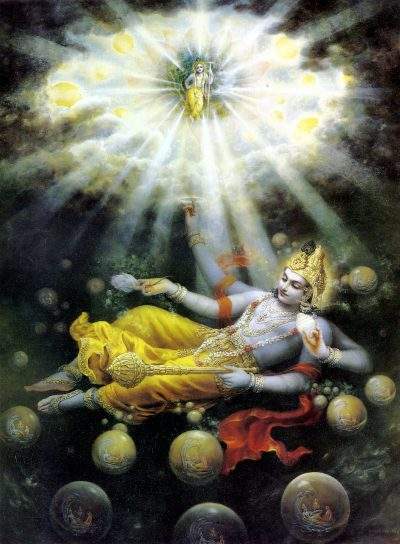
What is External Energy?
Krishna's external energy (bahiranga-shakti) is a distorted reflection of His internal energy, svarupa-shakti. Thus, the objects created by this energy do not have actual existence and cannot provide satisfaction to the jiva.
The Analogy of a Tree's Reflection
Just as a tree's reflection in water not only has distorted proportions (everything is reversed), but we also cannot pick fruit from such a tree because the tree itself is illusory. All material nature is called maya-jagad – the world of illusion, where the jiva hopes to find actual existence and shelter, but by definition these things cannot be found here.
External energy manifests as the material world and is the cause of countless universes in which various material energies operate. It is called external because it is qualitatively separated from the eternally spiritual body of the Supreme Personality of Godhead, much like milk, which is the cow's energy but is different from her.
bhūmir āpo 'nalo vāyuḥ
khaṁ mano buddhir eva ca
ahaṅkāra itīyaṁ me
bhinnā prakṛtir aṣṭadhā
"Earth, water, fire, air, ether, mind, intelligence and false ego – all together these eight constitute My separated material energies."
— Bhagavad-gītā 7.4
Is Material Energy Independent of the Lord?
Although material nature is separated from Krishna, nonetheless it is not independent. In the "Bhagavad-gita" (9.10), Krishna explains:
mayādhyakṣeṇa prakṛtiḥ
sūyate sa-carācaram
hetunānena kaunteya
jagad viparivartate
"This material nature, which is one of My energies, is working under My direction, O son of Kunti, producing all moving and nonmoving beings. Under its rule this manifestation is created and annihilated again and again."
Divine Energy is Insurmountable
Since material nature is related to God and obeys His will, it is called divine. Therefore, however much people try to overcome its influence or bend it to their will, they will not succeed. Only those who have surrendered to Krishna can easily overcome it (Bg. 7.14).
Why is it Necessary to Overcome Material Energy?
Consciously or unconsciously, a person's entire life is spent struggling with material nature. This happens naturally, because the material world is foreign to the nature of living beings.
Duḥkhālayam
Place of suffering – the material world is a place of misery.
Aśāśvatam
Temporary – everything a person achieves in this world is only a temporary gain.
The Four Primary Sufferings
janma
Birth
Mṛtyu
Death
Jarā
Old age
Vyādhi
Diseases
All the progress of modern civilization's science and technology is aimed at freeing humans from these sufferings. However, mankind will never succeed in avoiding these problems, because the material world is by definition a "place of suffering". Even if a person succeeds in reaching the heavenly planets, they will still encounter these sufferings.
The Three Types of Suffering
Ādhyātmika-kleśa
Sufferings caused by our own mind and body.
Ādhibhautika-kleśa
Sufferings caused by other living beings.
Ādhidaivika-kleśa
Sufferings caused by natural disasters, created by higher forces of nature.
The Three States
All objects in this world, from microscopic ones to universes, experience three states:
Sṛṣṭi
Creation (beginning)
Sthiti
Maintenance (middle)
Pralaya
Destruction (end)
Gunas – Subtle Forces
The Vedas teach that beyond external and visible processes, in the creation, maintenance, and destruction of everything, lie subtle forces that permeate everything in the material world. These forces are called gunas. The word guna means quality, mode, and also rope.
How to Get the Best Deal out of a Bad Bargain?
There are several common views of this material world:
1. Materialistic
This world is the only place that can be, so one must live in such a way as not to regret not having experienced or felt something. At the moment of death, everything will end.
2. Ascetic
This world is a curse to the soul. It is a place of suffering and the kingdom of the devil. Any association with this world condemns one to even greater suffering, so any contact with this world must be avoided.
3. Krishna Consciousness ✓
This material world is one of Krishna's energies, intended to correct stray souls. In this world, one should take only what is absolutely necessary and always remember to whom it all belongs. All things, including this body, should be used in service to the true master of the world and the body.
anāsaktasya viṣayān
yathārham upayuñjataḥ
nirbandhaḥ kṛṣṇa-sambandhe
yuktaṁ vairāgyam ucyate
"When one is not attached to anything, but at the same time understands everything in relation to Krishna, his position is correct and above the sense of ownership."
— Bhakti-rasāmṛta-sindhu 1.2.255
Yukta-vairagya – Proper Renunciation
The goal of practicing Krishna Consciousness is to always remember Krishna and never forget Him. The easiest way to do this is to always realize that the material world is one of Krishna's energies. When we look at the world and it seems wonderful to us, we can remember that Krishna created it so wonderfully.
Two Energies of Krishna
"Bhagavad-gita" Ch. 7 describes that Krishna has two energies – para and apara – higher and lower.
Apara prakṛti – Lower
Eight material elements: earth, water, fire, air, ether, mind, intelligence, and false ego. Of these, 5 are gross (mahā bhūta) and 3 are subtle (sūkṣma bhūta).
Para prakṛti – Higher
Spiritual souls – living beings who utilize the resources of material lower nature. Thanks to them, this material world functions.
Important to Understand
Both the higher nature and the lower nature are entirely dependent on the Lord for their existence. Although qualitatively we are identical to Him, quantitatively we are atomic sized souls (aṇu ātma), while the Lord is the infinitely great soul (vibhu ātma). Being infinitely small spiritual souls, we are always inclined to fall under the influence of illusion.
Krishna's Opulences (vibhūti)
Krishna is the essence of everything. Everything that we see or are able to accept as an exceptional quality of an object depends on Krishna. In the tenth chapter of the BG, Krishna explains how to know Him in this world.
yad yad vibhūtimat sattvaṁ
śrīmad ūrjitam eva vā
tat tad evāvagaccha tvaṁ
mama tejo-'ṁśa-sambhavam
"All that you see beautiful, powerful or valuable in this existence, all that you give meaning to, do not reject, but delve into it every time, and you will see that what you so value in this world actually arises from a tiny fragment of My splendor."
— Bhagavad-gītā 10.41
Krishna's Opulences (from Bg. Chapter 10)
- Of the Adityas – Vishnu
- Of luminaries – the radiant Sun
- Of the Vedas – Sama Veda
- Of the demigods – Indra
- Of the senses – the mind
- Of the Rudras – Lord Shiva
- Of mountains – Meru
- Of priests – Brihaspati
- Of sages – Bhrigu
- Of sound vibrations – Om
- Of trees – the banyan
- Of weapons – the thunderbolt
- Of animals – the lion
- Of birds – Garuda
- Of rivers – the Ganges
- Of sciences – the science of the Self
- Of letters – the letter A
- Of months – Margashirsha
- Of seasons – spring
- Of the Pandavas – Arjuna
Conclusion
Krishna permeates this entire cosmic manifestation with only a tiny part of Himself. Realizing how grand this world is, we can only try to vainly imagine the spiritual world, which is the manifestation of Krishna's free and unlimited internal power. Realizing this creation as God's artifact, we can understand at least some of God's plans for us.
QUESTIONS
Self-Check Questions
- Is the material world evil?
- What problems do living beings encounter in this world?
- What should be a person’s relationship with matter?
- List the 8 material elements in order from subtle to gross.
- In what way is Krishna all-pervading?
- List at least ten of Krishna’s opulences from the tenth chapter.