Even when seeking material knowledge, a teacher, a specialist in their field, is required. Although formally, anyone can learn everything by reading books, practically doing so is very difficult. We see that there are so many educational institutions, schools, courses, whose goal is to provide a person with the opportunity to learn from a qualified teacher. To learn any subject, not only theory but also practice is required. Without a teacher, a person will very rarely be able to be sure that they have learned the subject correctly, because one of the teacher's tasks is to check and confirm the student's practical and theoretical knowledge.
Even if it is formally possible to acquire some material knowledge independently, without a teacher, it is impossible to acquire spiritual knowledge in this way. This is because material objects are always accessible to our senses, either directly or through measuring instruments. A teacher is needed to explain and systematize these phenomena. Spiritual objects do not show themselves to our senses in any way. The conditioned soul has no suitable tools to determine the existence of spiritual energy. One can learn about it only from a personality who has purified their consciousness to such an extent that it has become a tool sensitive to spiritual energy. Such a personality is called a spiritual master. Secular education is primarily based on knowledge and the ability to use it. Spiritual education is primarily based on practice, the cultivation of the powers of consciousness. Theoretical knowledge and erudition have no intrinsic value here, as in material science. Therefore, a spiritual master is needed who would teach us how to develop Krishna consciousness, and not just help us learn new things.
Why is a spiritual master necessary?
Is a spiritual master necessary for everyone? Although all living entities suffer in the material world, becoming victims of Maya, not every soul wants to be liberated from this suffering. Some stubbornly try to find their own path to happiness. Such a person does not need a spiritual master. He is needed only for one who has become curious (wanted to know) about transcendence (athāto brahma jijñāsā – Vedanta Sutra 1.1.1).
Reasons why we need a spiritual master:
- First, with their polluted mind, a person tends to perceive information in a distorted way. A genuine spiritual master helps to correctly understand what is written in the Vedas.
- To understand spiritual knowledge, a person must develop certain qualities, and for this, the help of a spiritual master is required. He engages the disciple in a certain practice necessary to develop these qualities.
- By accepting a spiritual master, a person takes a humble position (avaroha-pantha), which disposes their heart to accept this knowledge. Without taking such a position, it is impossible to receive transcendental knowledge.
- To develop faith, we need a living example, a person who has walked this entire path. Such an example inspires us.
- Parampara (the disciplic succession through which knowledge is transmitted) must not be broken, otherwise the knowledge will be distorted.
All avatars of Krishna who descended accepted a formal guru
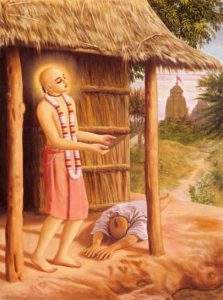
We may not understand that something is particularly important. However, an intelligent person understands what is important by observing how great personalities behave. Chaitanya Mahāprabhu Himself accepted a spiritual master to set an example for us. Since He acted as an acharya (one who teaches by their example), He showed how important it is to accept a spiritual master. Meeting Prakashananda Sarasvati – a famous Mayavadi sannyasi, Chaitanya Mahāprabhu said that the teacher considered Him too foolish to study Vedanta, so ordered Him to chant the names of Krishna. In this way, Chaitanya Mahāprabhu was able to achieve the perfection of life.
Another example is Vyasadeva. Although he wrote down the Vedic literature and is considered the literary incarnation of Lord Narayana, although he is a teacher and authority for all, he himself accepted Narada Muni as his teacher. Srimad-Bhagavatam tells that Srila Vyasadeva, even after writing down all the Vedic literature, did not feel internal satisfaction. The voice of conscience gnawed at him, but he could not understand the reason. Narada Muni explained to Vyasadeva that he had described in his works karma – material activity, and jnana – the path of philosophical speculation, but these paths are not the true function of the soul. Narada told Vyasadeva about the nature of the spirit soul and its constitutional activity. When Vyasadeva, following the guru's instruction, wrote Srimad-Bhagavatam, his work was crowned with complete success.
Lord Ramachandra
Descended to this earth as a human being, a king, to liberate people from the yoke of Ravana and other demons. To learn His dharma (duty) and how to perform it, He accepted a spiritual master – Vishvamitra, who taught Him Vedic mantras and gave Him his blessings.
Krishna and Balarama
Even Krishna Himself and Balarama accepted a spiritual master Sandipani Muni, and acted as diligent brahmacharis (students). They carried out all their guru's instructions and received blessings from him that everything they said would be true.
Important!
A person who claims that they do not need a spiritual master, and at the same time teaches others, is an imposter. Even if they proclaim themselves an incarnation of God, by their behavior they deny it.
To become cultured, a person must take an interest in the meaning of life
Webster's dictionary defines the word culture [lat. cultura – cultivation, upbringing, education, training, improvement, development, worship] as:
- Development of intellectual and moral capabilities, especially through education;
- Care, upbringing and nurturing (physical culture, beauty culture);
- Discernment of taste and knowledge thereof, acquired through intellectual and aesthetic upbringing;
- Taste and acquaintance with art, humanism, and general scientific questions, as distinct from eloquence or technical abilities.
- Certain attitudes of human cognition, beliefs and behavior, depending on the ability of the majority to learn and transmit knowledge to future generations.
- Local customs and beliefs, forms of social behavior and material aspects of a racial, religious or social group.
- A set of common attitudes, values, goals and practices that characterizes a company or corporation.
Speaking of culture as the development of intellectual and aesthetic capabilities, it is impossible to imagine culture ignoring self-realization. Although there are plenty of cultures that know nothing about the soul, this is not because the question of self-realization is unimportant to them, but because opportunities or methods to know the soul are not found. Then arises material culture, recognizing the personality as a product of matter.
About culture and the spiritual master
A person seeking spiritual, or true, culture must approach a spiritual master, otherwise they will become a victim of the limitations of material culture. In Vedic society, a person was not considered cultured if they did not have a spiritual master, because this meant that they did not receive proper spiritual education. The Sanskrit word arya, which nowadays is interpreted as a racial characteristic, actually means a cultured person who knows the values of life. According to Krishna's description, an arya does not lament for the body, but cares for the soul.
The spiritual master is the only one who can solve life's problems
Faced with great difficulties and finding no way out, a cultured person turns to a spiritual master. This shows that a cultured person is not required to know everything, but is required to know the principles of life. Therefore, having fallen into trouble, Arjuna turned to Krishna not as a friend, but as a spiritual master. BG 2.7 says:
kārpaṇya-doṣopahata-svabhāvaḥ
pṛcchāmi tvāṁ dharma-sammūḍha-cetāḥ
yac chreyaḥ syān niścitaṁ brūhi tan me
śiṣyas te 'haṁ śādhi māṁ tvāṁ prapannam
"Now I am confused about my duty and have lost all composure because of miserly weakness. In this condition I am asking You to tell me for certain what is best for me. Now I am Your disciple, and a soul surrendered unto You. Please instruct me."
Vedic knowledge can be understood only from a spiritual master
Vedic knowledge is called apaurusheya – superhuman. A person entangled in the labyrinths of their mind cannot understand elementary truths of life. Guided by emotions, rather than a sober head, they think that their ambitions are always right, and if others do not agree, they are wrong. With such weak discernment, how can a person understand Vedic statements speaking about transcendence. Even in sacred scriptures they will see confirmations of their ambitions, as Mahatma Gandhi, Dr. Radhakrishnan, Ramakrishna, Rajneesh and others saw. A spiritual master is needed who would depend on Krishna, and not on our ambitions, to be able to tell the truth as it is. Only a spiritual master can explain Vedic truths disinterestedly, without having their own ambitions and without catering to the whims of an influential or ambitious disciple.
The Vedas speak about what is beyond the experience of senses and mind. Since the Vedas use words that mean material things to us, we are inclined to interpret transcendental information materially, to base it on our experience. About what is beyond the perception of mind and senses, one must ask one who has known it. A spiritual master will not allow material interpretation of spiritual knowledge, but rather will provide spiritual experience.
To be liberated from material existence is possible only by approaching a spiritual master. The Vedas describe many ways to be liberated from material existence. Unfortunately, many of them are not effective in themselves. They are presented only as intermediate methods, helping to overcome weakness of will and spiritual stagnation. Conditioned souls evaluate all these paths for attractiveness and convenience, but not for effectiveness. A spiritual master knows Krishna's will and indicates the path that is most effective, even if not so pleasant.
About the bonds of gunas
A bound person cannot untie themselves. Someone free is needed to untie them. In Bhagavad-gita 7.13 Krishna says that the whole world is deluded by the modes of material nature, therefore no one can know Him, who is above the modes of nature. The word guna in Sanskrit means ropes. All living entities are bound by the ropes of goodness, passion or ignorance. Therefore no one can liberate themselves and no one can liberate others. The spiritual master is the embodiment of Krishna's mercy, whom He Himself sends to liberate those souls who sincerely seek it.
The spiritual master extinguishes the fire of material existence, in which we have been burning for many lives, finding no place for ourselves. Srimad-Bhagavatam 7.9.17 says that all living entities, avoiding unpleasantness and seeking pleasures, are constantly burned in the fire of desires. They find various methods to extinguish this fire, but these become the cause of new, even greater suffering. The only way to extinguish this fire is dasya yoga – service to the Supreme Personality of Godhead, which only a spiritual master can teach, because he is a close servant of Krishna.
From a spiritual master a person receives perfect knowledge
The teacher sees the truth, therefore he can transmit it to others. It is often difficult to explain to another what we have simply learned, but when we understand something, we can explain it to different personalities in many ways. The diversity of religious teachings and disagreements between religious directions arise because their propagators and followers themselves have not seen the truth, have only heard or read about it or speculated. Those who have realized the Absolute Truth explain it as it is set forth in the Vedas. Therefore, there remain no contradictions. Therefore in Bhagavad-gita Krishna says: tad viddhi praṇipātena … – humbly approach a spiritual master who has known the Absolute Truth. He will solve all contradictions arising in the mind due to the diversity of spiritual paths. The spiritual master will dispel the darkness of ignorance with the lamp of knowledge and open the door to the spiritual world.
A person without the help of a teacher cannot understand even the nature of the soul, because Vedic knowledge alone is not enough. A living example is needed. The spiritual master knows the Lord and His creation and knows how to distinguish energy from the source of energy. He does not lump the Lord and His parts into one pile.
Spiritual life means practice that spiritualizes (purifies) our senses. This practice must be performed under the supervision of a proper guide. Therefore Rupa Gosvami's Bhakti-rasāmṛta-sindhu 1.2.234 says:
ataḥ śrī-kṛṣṇa-nāmādi
na bhaved grāhyam indriyaiḥ
sevonmukhe hi jihvādau
svayam eva sphuraty adaḥ
No one can understand Krishna as He really is with their blunt material senses. However, the Lord Himself reveals Himself to His devotees, being pleased with their transcendental loving service.
A person approaches God through a spiritual master
Service to the Lord begins with serving His representative – the spiritual master. One cannot approach Krishna directly for several reasons:
- We cannot see God with material vision;
- The Lord does not accept upstarts.
To approach any great personality, first one must pass through security, deputies, close associates. It is the same with Krishna. He does not let just anyone near Him. However, this does not mean that He is afraid of getting dirty. The motives of a self-willed and independent person to see God are not clean. They absolutely do not need God, but it is enough to become a great personality. Or they want to dictate their conditions to God. They are like a person who, having insulted another, offers to make peace, but is not going to apologize.
To see God and be able to serve Him, one needs to develop a little humility. Without it, it is impossible to serve God purely, without having personal motives. Humility must be learned by serving God's representative. This is not an idea invented by a group of privileged people, caste brahmanas or family gurus. Krishna Himself speaks about this in many scriptures. He orders not to make a distinction between Him and the spiritual master. In Srimad-Bhagavatam 11.17.27 Krishna says:
ācāryaṁ māṁ vijānīyān
nāvamanyeta karhicit
na martya-buddhyāsūyeta
sarva-deva-mayo guruḥ
"One should know the acharya as Myself and never disrespectful to him in any way. One should not envy him or think of him as an ordinary man, for he is the representative of all the demigods."
Again, the Lord loves and values His devotees so much that He serves them Himself. An example is Narada Muni, whose feet Krishna used to wash when he visited His home in Dwaraka. When the brahmana Sudama Vipra visited Krishna's home, He was so pleased with the simple rice that the brahmana brought to treat Krishna. He is not so pleased with opulent rituals that people perform to achieve their goals. Srimad-Bhagavatam tells the story of the famous yogi Durvasa Muni and King Ambarisha. The king was a simple devotee of the Lord, while Durvasa Muni was famous as a strict yogi full of mystic powers. When the angry yogi wanted to kill Maharaja Ambarisha, Lord Narayana sent His weapon – the chakra, to defend the devotee. This weapon began to chase the yogi and he had to seek shelter with Brahma and Shiva, and finally with Lord Narayana Himself. But the Lord answered him: "I cannot help you at all, because I am completely dependent on My devotees. I am not independent – My heart belongs to them. Ask forgiveness from the devotee, because only he can stop your suffering. Such is the supreme power of a devotee." The Lord wants His devotees to be served more than Himself. To one who sincerely serves Krishna's devotees, Krishna reveals Himself in return and thus grants complete bliss to the devotee. In the Adi Purana Krishna states to Arjuna that one who claims to be Krishna's devotee is actually not, while one who says they have surrendered to Krishna's servant is Krishna's actual devotee. For one seeking enlightenment, the first thing is to accept such a devotee as their teacher and serve him.
64 items of devotion
Rupa Gosvami in the book "Bhakti-rasamrita-sindhu" lists 64 items of devotional service activity. The first 10 refer to principles, and all others to details. Among the first – the three most important: accept the shelter of a spiritual master; follow the spiritual master's instructions and receive initiation from him; serve the spiritual master with affection.
A critic will object: why are intermediaries needed to know God? This mindset is very common in the West. In Christianity, it gave birth to Protestantism, claiming that a person can approach God without intermediaries. Of course, their protest was caused by the clergy, who claimed that the only way to please God is complex rituals that a simple person cannot perform. For the clergy, this meant recognition and power. However, an intermediary does not necessarily have to be an obstacle between man and God as happened in Christianity. An intermediary can be a helper in seeking to know God. The spiritual master is like a transparent medium, transmitting our service directly to Krishna, not keeping it for himself. We can give an example with glasses. A person suffering from myopia cannot see what is happening a few meters away, but with glasses they see perfectly. In this way, this transparent medium shows us, spiritual myopics, Krishna, which would normally be impossible.
A polite person does not seek to get acquainted with another person directly, they do it through a mutual friend or a representative of the important person. So also one wishing to get acquainted with Krishna should not try to do it directly, so as not to be considered arrogant. Rather one should approach one who is especially dear to the Lord.
"One should be the servant of the servant of the servant of the servant of Krishna" – Chaitanya Mahāprabhu
This principle of serving not Krishna directly, but Krishna's representatives, means the disciplic succession, where everyone is a servant of their teacher. Such a chain extends towards Krishna and no one loses anything, even if the chain is very long. To serve a devoted servant of God in the disciplic succession is the first condition on the path of devotional service.
Without guru's mercy – there is no Krishna's mercy
Without the spiritual master's mercy, a person will not be able to receive Krishna's mercy (yasya prasādād bhagavat-prasādo yasyāprasādān na gatiḥ kuto 'pi). Here fits the example with the sons of Kuvera, whom Devarshi Narada cursed to become trees, so that later Krishna Himself would liberate them.
The spiritual master gives the disciple initiation or gives an impulse to spiritual life. This impulse is externally manifested in that the disciple takes vows in the presence of the guru, and the guru promises to introduce the disciple to Krishna. Krishna Himself chose such a way to give knowledge, therefore one cannot expect that He will give someone this impulse of spiritual life internally. Brahma received initiation through the heart, because he was the first being in the universe, and Krishna was his first teacher.
In Vaishnava spiritual practice, this principle of approaching Krishna through a spiritual master manifests in that during rituals, every item of worship offered to Krishna is first offered to one's spiritual master. He transmits the worship to his spiritual master, and he to his, so until finally it reaches Krishna. In this way, any act of worship is purified from material contamination.
One can know the Lord only through a spiritual master
One must receive the spiritual master's instructions on how to understand Krishna's Personality, His Name, form, pastimes, His words. We cannot invent these things ourselves. The teacher must personally guide spiritual advancement. When a disciple personally encounters Krishna, they realize that it is only by the mercy of the spiritual master. Sanjaya, who narrated the Bhagavad-gita, heard Krishna's conversation with Arjuna by the mercy of Vyasadeva, his spiritual master. Although he was many miles away from the battlefield, his experience was direct. In this way, a devotee directly experiences Krishna by serving and following the spiritual master's instructions.
The Lord is not accessible by studies or speculations alone. Brahma-samhita states: vedeṣu durlabham adurlabham ātma-bhaktau – The Lord is not understandable by Vedic studies, but easily accessible by devotional service.
Having implemented the spiritual master's teachings and instructions, one can see the Lord face to face. From the teacher a person receives transcendental vision, with the help of which one can see the Lord. About such transcendental knowledge, which is received by humbly serving the spiritual master and inquiring from him, Krishna speaks in Bhagavad-gita 4.35 verse:
yaj jñātvā na punar moham
evaṁ yāsyasi pāṇḍava
yena bhūtāny aśeṣāṇi
drakṣyasy ātmany atho mayi
"Having acquired real knowledge from a self-realized soul, you will never fall into illusion again, for by this knowledge you will see that all living entities are but part of the Supreme, or, in other words, that they are Mine."
Without a spiritual master, all of a person's discoveries in the field of religion are a demonstration of their stupidity. An example is crazy personalities who imagine they are serving Krishna and receiving instructions directly from Him. However, these instructions contradict Krishna's words in Bhagavad-gita, and are completely selfish.
The spiritual master shows what Krishna wants from us
In order to be able to serve Krishna, first we must understand what Krishna wants. We cannot serve Krishna by doing what we want ourselves. This is not service, but speculation. Therefore, one must ask the teacher, who knows what Krishna wants, and how to serve Krishna without selfish motives. One can serve Krishna only having reached a pure spiritual level. However, to reach such a level without serving Vaishnavas is impossible.
The spiritual master provides a taste for devotional service
The transcendental message coming through the lips of a pure devotee is even sweeter than coming directly from the Lord's words or sacred scriptures. Because the devotee adds the reflection of their love to the Lord's words. An example is Sukadeva Gosvami and Prabhupāda's books.
Self-Check Questions
- Explain why it is necessary to accept a spiritual master?
- Is it possible to achieve love for God by only purely chanting Hare Krishna and not having accepted a spiritual master?