How is Vedic knowledge received?
Verse 9 of the Sri Ishopanishad states that ignorance leads to darkness, but misunderstood knowledge leads to even greater darkness. Modern civilization has made great progress in scientific understanding of the world, yet people have become even more unhappy. True knowledge must bring happiness, not suffering. It must change the person, not the environment. But what we learn and how we learn it influences the quality of knowledge.
Three main sources of acquiring knowledge
1) Pratyaksa
Direct experience obtained through senses and mind. Empirical method [Gk. empeiria], based on perception.
2) Anumana
Logic and inferences drawn from observing the world directly. Also an empirical method, based on independent analysis.
3) Sabda
Voice of authorities and scriptures. This represents synthesized knowledge from a reliable source, capable of revealing what senses cannot reach.
Let us note that the first two methods are based on independent collection of facts and their analysis. The third method means that we receive already synthesized and analyzed knowledge from a reliable source. Direct experience and conclusions only strengthen our trust in authorities. The third method can tell us about things we would never learn exist if we relied only on our senses.
Induction and Deduction
A person starting to study the Vedas can use one of two methods:
Induction (Aroha-pantha)
[Lat. inductio – leading into] Ascending path of knowledge.
When we seek to understand increasingly complex things with the help of our mind. A person does not turn to authorities and tries to find out the truth by their own efforts.
Deduction (Avaroha-pantha)
[Lat. deductio – leading down] Going from top to bottom.
The most perfect method allowing us to know ourselves. A person receives knowledge from an authoritative source (Vedas). Conclusions are always precise.
Katha Upanishad 1.2.23 says:
"The Supreme Lord cannot be attained by expert explanations, by vast intelligence, or even by much hearing. He is attained only by one whom He Himself chooses. To such a person, He reveals His own true form."
Freedom of Knowledge and the Descending Path
What is the relationship between freedom of thought and the authority of scriptures? Bhaktivinoda Thakura in his famous lecture "The Bhagavata: Its Philosophy, Its Ethics, and Its Theology" (1869) writes:
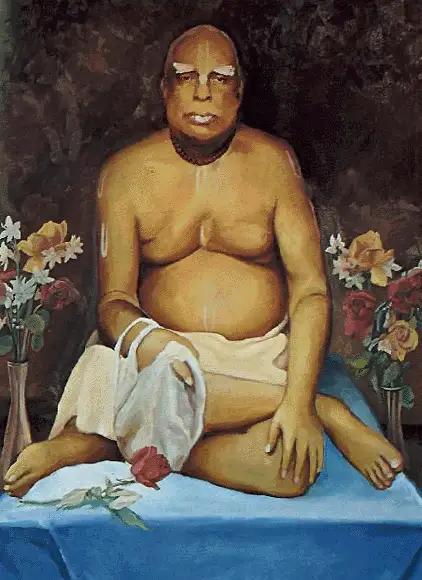
Srila Bhaktivinoda Thakura:
"The Bhagavata teaches us that God gives us truth... when we earnestly seek it... Our shastras, or in other words, books of thought, do not contain everything that we could get from our Father... God's revelation is absolute truth, but it is very rarely received and preserved in its original purity...
Vyasa was not satisfied with what he had collected in the Vedas... The peace of conscience did not sanction his works... It told him internally: 'No, Vyasa! You cannot rest contented with a wrong picture of truth... You must yourself knock at the door of the inexhaustible storehouse of truth...'
We are not to be led by those who lived and thought before us. We must think for ourselves and try to get further truths which are still undiscovered... Thus the Bhagavata is a religion of liberty, of unmixed truth, and of absolute love."
From this speech, we can conclude that the highest spiritual aspiration is defined by the peace of a person's conscience (inner peace). Shastra gives us the freedom to ask and seek answers ourselves, while offering its help. Krishna wants us to walk ourselves, to seek the path, to gain our own experience and to confirm all spiritual truths by ourselves.
Freedom and Obedience
Freedom is an attribute of the soul, not of matter. A living entity controlled by material conception risks misunderstanding the principle of freedom. By limiting the needs of the body, a person liberates the soul from dependence on them.
Only a person who obeys scriptures and spiritual authorities can liberate themselves from the coercion of matter. Only then, having liberated their spiritual intelligence, can they seek truths that no one has found until now.
What does avaroha-pantha mean practically?
It means accepting the guidance of a spiritual master. Bhagavad-gita (4.34) says:
tad viddhi praṇipātena
paripraśnena sevayā...
Just try to learn the truth by approaching a spiritual master. Inquire from him submissively and render service unto him. The self-realized souls can impart knowledge unto you because they have seen the truth.
Also, the Shvetashvatara Upanishad (6.23) confirms: "Only unto those great souls who have implicit faith in both the Lord and the spiritual master are all the imports of Vedic knowledge automatically revealed."
5 Stages of Assimilating Vedic Knowledge
Pratyaksa
Knowledge through one's own senses. Observing the teacher (acharya) and following his example.
Paroksa
Indirect knowledge through another person's senses. We see the truth through the eyes of another, spiritually more advanced person.
Aparoksa (Realization)
Immediate, direct knowledge. The disciple begins to understand the philosophy and see everything through this understanding. Spiritual anumana is used.
Adhoksaja (Revelation)
[adhah – down, aksha-ja – senses]. That which lies beyond sense perception. Knowledge is received bypassing the imperfect layer of the mind.
Aprakrita
Spiritual vision. A person observes true spiritual reality and God's activities. [aprakrita – non-material].
Parampara and Sampradayas
Parampara means that which follows one after another. Param param – higher and higher, all the way to Krishna. If the chain breaks (becomes apasampradaya), Krishna Himself must restore it. In these times, there are four authoritative Vaishnava sampradayas:
Lakshmi (Sri)
Ramanujacharya
Brahma
Madhvacharya
Shiva (Rudra)
Vishnu Swami
Kumaras
Nimbarka
Self-Check Questions
- What are the methods of acquiring knowledge?
- What are the defects of a conditioned soul?
- Explain the difference between inductive and deductive methods?
- Explain the necessity of receiving knowledge from a proper source.
- Explain the principle of parampara?
- Quote verse BG 4.2 from memory.