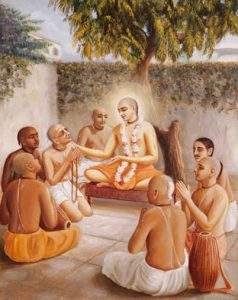
Who is a guru
Guru is the representative of Krishna Himself. In this respect, he is no different from Krishna. Therefore Vishvanatha Chakravarti Thakura sings:
sākṣād-dharitvena samasta-śāstrair
uktas tathā bhāvyata eva sadbhiḥ
kintu prabhor yaḥ priya eva tasya
vande guroḥ śrī-caraṇāravindam
The spiritual master is to be honored as much as the Supreme Lord, because he is the most confidential servitor of the Lord. This is acknowledged in all revealed scriptures and followed by all authorities. Therefore I offer my respectful obeisances unto the lotus feet of such a spiritual master, who is a bona fide representative of Sri Krishna.
Meaning of the word "Guru"
Guru means heavy. He is heavy with knowledge. On the other hand, the spiritual master is not meant for entertainment. Only a serious person can approach a spiritual master.
Variety of spiritual masters
First of all, it must be noted that the Supreme Personality of Godhead existed before other spiritual masters appeared, therefore He is glorified as the Original Spiritual Master. Only He alone possesses the most complete and perfect knowledge. He sends a message to His lost children, by means of which they can return to the transcendental blissful world. All other spiritual masters are His representatives. Their function is to transmit transcendental knowledge without distortion, so that conditioned souls could return home, back to Godhead. Therefore they are called shiksha gurus – spiritual masters (guru means heavy, i.e. full of knowledge), transmitting shiksha (spiritual knowledge).
Although the role of all spiritual masters is to transmit spiritual knowledge (therefore they are all shiksha gurus), still different spiritual masters perform different functions in this process, therefore they are called differently:
Adi-guru
The founder of the disciplic succession (sampradaya). Adi guru receives knowledge directly from the Supreme Lord Himself and transmits it to his disciples. Examples: Brahma, Shiva, Kumaras and Lakshmi.
Founder-Acharya
A spiritual master who corrects contradictions and gives a new direction to the mission. Such a spiritual master is a special devotee whom the Lord empowers personally. Examples: Ramanuja, Sri Madhva, Srila Prabhupāda.
Vartma-pradarshaka-guru
The spiritual master who shows the path. This is the one who for the first time shows a person the right path to God. This does not necessarily have to be a pure devotee. Sometimes even materialists show a curious person where the Hare Krishna temple is.
Shiksha-guru
A spiritual master giving instructions based on scriptures. This is a personality who can give us knowledge by which we can progress. An inquisitive disciple can have many shiksha-gurus.
Diksha-guru
A spiritual master giving initiation into the disciplic succession. Such a master takes not only the responsibility to impart knowledge to the disciple, but also commits to bringing the disciple to Krishna.
Sannyasa-guru
A spiritual master conferring sannyasa – initiating into the renounced order of life.
Important to remember
All these different categories of spiritual masters perform different functions in transmitting spiritual knowledge. All of them are representatives empowered by God, through whom He shows His infinite mercy to conditioned souls. Therefore, great respect should be shown to all these spiritual masters. Ignoring them or offending them means an obstacle on the spiritual path.
How does the Lord help the soul acquire spiritual knowledge through the mediation of these spiritual masters?
- In the beginning, the Lord personally teaches the founder of the disciplic succession (adi-guru), who transmits this knowledge to his disciple, and he in turn to his disciple. Thus this knowledge is transmitted from master to disciple undistorted.
- If due to the devastating influence of this age some distortions of the teaching begin or understanding disappears, the Lord sends his special representative founder-acharya, who corrects the teaching. Quite recently Srila Prabhupāda performed this function.
- A person entangled in this world meets vartma-pradarshaka-guru, with whose help the Lord shows him the path.
- Later, the God-seeking person meets people devoted to God, who play the role of shiksha-guru for him.
- Of all shiksha-gurus the one whose instructions most inspire the disciple usually becomes his diksha-guru.
- Later follow other shiksha-gurus, who continue his teaching.
Relationship between Diksha and Shiksha Guru
Dikša-guru can be only one, and he is the first or true spiritual master. Šikša-guru can be many – they support dikša-guru instructions and occupy a subordinate position.
The difference between dikša and šikša guru is determined by the duties they perform, but this should not become a reason for a materialistic tendency to belittle others. A disciple must learn to see the manifestation of the Supreme Personality of Godhead in the persons of his dikša-guru and many šikša-guru.
Qualities and duties of a spiritual master
In order for the master to be able to lead his disciple to Krishna, he himself must have proper qualities and qualification. Scriptures speak a lot about these qualities, as well as Vaishnava acharyas.
Srimad Bhagavatam 11.3.21 says:
tasmād guruṁ prapadyeta
jijñāsuḥ śreya uttamam
śābde pare ca niṣṇātaṁ
brahmaṇy upaśamāśrayam
"Therefore any person who seriously desires real happiness must seek a bona fide spiritual master and take shelter of him by initiation. The qualification of the bona fide guru is that he has realized the conclusions of the scriptures by deliberation and is able to convince others of these conclusions."
This verse speaks about two main and one secondary qualities of a spiritual master.
1. Shabda-brahmani nishnatah
He has realized the conclusions of the scriptures and can convince others of their correctness:
- Never says what is not in Vedic literature
- Constantly studies scriptures
- Never contradicts sadhus (saints)
- Can answer any question about spiritual life
- Teaches by his own example (acharya)
- Just and friendly to everyone
2. Para-brahmani nishnata
Has taken shelter of the Supreme Lord and is established on the spiritual platform:
- Never says "I am God"
- Speaks only about God or what is related to Him
- Absorbed in chanting the Holy Name of the Lord
- Absorbed in devotional service to God
3. Secondary quality: Upashamamshrayam
He is indifferent to the temptations of the material world. Rupa Gosvami in "Nectar of Instruction" (verse 1) says about this:
jihvā-vegam udaropastha-vegam
etān vegān yo viṣaheta dhīraḥ
sarvām apīmāṁ pṛthivīṁ sa śiṣyāt
"A sober person who can tolerate the urge to speak, the mind's demands, the actions of anger and the urges of the tongue, belly and genitals is qualified to make disciples all over the world."
Essential quality
The spiritual master must belong to a disciplic succession (parampara).
Bhaktivinoda Thakura on the qualities of pure devotees
Bhaktivinoda Thakura presents essential qualities of a pure devotee, which are very important for a guru:
- Simplicity (saralata)
- Determination (dridhata)
- Exclusive devotion only to the Lord (ekantata)
- Even if people contradict him, he will never give his permission or support to activities contrary to pure bhakti.
- He never expects anything from others.
Scriptures distinguish these qualities:
- The spiritual master strictly follows the principle of parampara and scriptures
- Understanding the science of Krishna is the requirement to become a spiritual master, not his birth or social position.
- The spiritual master must know Vedic literature.
- To become a spiritual master one must receive authorization from Krishna and one's own spiritual master.
- The spiritual master must be a representative of Krishna
- The spiritual master must be a devotee of Krishna.
- The spiritual master must be a pure devotee, maha-bhagavata or uttama-adhikari.
- The spiritual master is a confidential servant of Krishna
- The spiritual master must be able to deliver his disciples from birth and death.
- The spiritual master must teach by his personal example.
- The spiritual master must control his senses.
- The spiritual master's body is spiritual.
- The spiritual master's ecstasy.
Summarized qualities from Hari Bhakti Vilasa:
✓ Guru must be:
- Knowing Vedas and scriptural conclusions
- Absorbed in worship of the Lord and chanting the Lord's names
- Peaceful, fully satisfied in devotional service activities
- Having deep faith in the Lord
- Exhibiting all good qualities
- Intelligent, steady, auster and just
- Of sweet speech, pleasant appearance
- Expert in arguments and judgement
- Grateful for service
- Concerned about the welfare of other living entities
✗ Guru must not:
- Desire money, fame or service from disciples
- Desire to accumulate material things
- Be attached to receiving gifts
- Hesitate when making decisions
- Eat too much
- Be prone to sleeping
- Criticize others' good qualities
- Speak about others' sinful activities
- Associate with people of low character
- Indulge in useless philosophies
Duties of a spiritual master
- The spiritual master teaches his disciples
- The spiritual master engages his disciples in service to Krishna
- The spiritual master delivers the disciple from material existence
- The spiritual master chastises the disciple (for his benefit)
- The spiritual master rejoices seeing the disciple's advancement
- The spiritual master is a preacher
- The spiritual master instructs and empowers his disciple to preach
- The spiritual master engages his disciple in Deity worship
- The spiritual master engages his disciple in cooking, offering and distributing prasadam
- The spiritual master never calls himself God
- The spiritual master must be free from material motives
How to choose a spiritual master
Important!
Choosing a spiritual master is a serious step in a disciple's life. A hasty attraction to a spiritual master may turn out to be a too unstable foundation in relationship with him, compared to a spiritual master who gave understanding through listening and long association. Initial attraction to a spiritual master can be contaminated by various material conceptions – friendly manner of speaking, personal charm, guru's charisma or his talents. When choosing a spiritual master, one must first look at how he himself follows his spiritual master.
If you have doubts about who is your guru
Srila Jayapataka Swami suggests a few criteria. First one must pray to Srila Prabhupāda, Nitai-Gauranga and Lord Krishna to receive their blessings and inspiration.
Most likely this is your guru:
- If you are inspired by this spiritual master, his enthusiasm and intensity of devotional service
- If you are inspired by this spiritual master's preaching and he strengthens your enthusiasm
- If you believe that sound vibrations coming from this spiritual master are full of Krishna consciousness
- If you have a desire to help this spiritual master in performing his mission
- If this spiritual master cares more about your spiritual welfare
- If you want a strong relationship with this spiritual master
- If this spiritual master strengthens your faith in Srila Prabhupāda
- If you feel that Krishna and Srila Prabhupāda express their will through this spiritual master
- If this spiritual master's preaching dispels your doubts and removes your anarthas
- If you are able to open your heart to this spiritual master
- If in your opinion this spiritual master best matches the symptoms of a guru described in "Gurvashtaka"
- If you fully rely on this spiritual master
- If you feel a deeper attachment to this spiritual master
- If this spiritual master can show you the best qualities of a devotee
- If by executing this spiritual master's instructions you feel that you are approaching Krishna
In which cases can a disciple reject his spiritual master?
Reasons for rejection
One can reject a spiritual master if:
- He falls down from the spiritual position, indulging his senses
- Becomes a mayavadi (declares himself God)
- Offends people dedicated to God
- Performs abominable acts, hiding under the mask of a devotee
⚠️ If a disciple rejects his diksha-guru for any other reasons, he commits a very serious offense!
Before making a decision to reject a spiritual master, a disciple should first approach senior devotees and humbly sharing his doubts, ask for their advice.
Self-Check Questions
- Who is a spiritual master?
- Tell about the categories of spiritual masters?
- What should be the personality of a spiritual master?
- In which cases can a disciple reject his spiritual master?