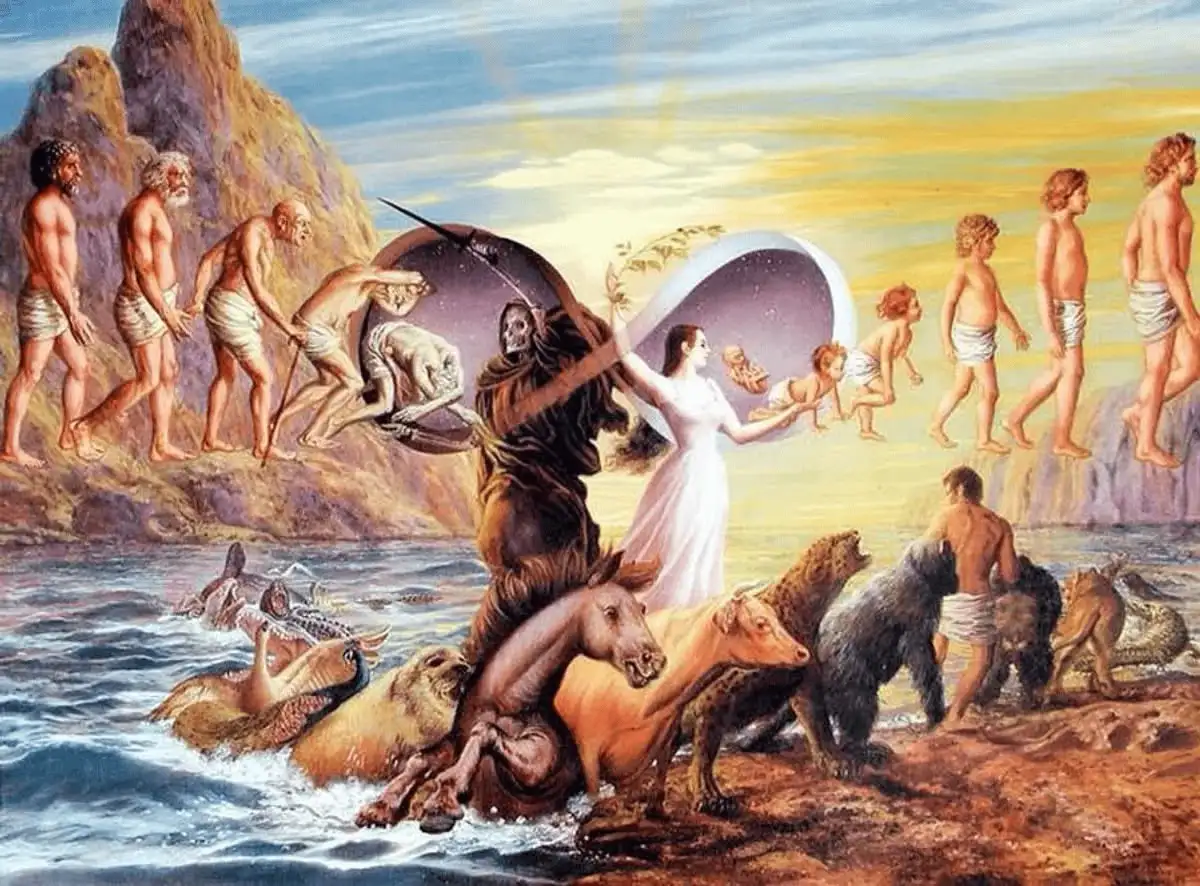
Reincarnation translated from Latin means the soul's repeated embodiment after death in different bodies. In Vedic literature the term samsara is used.
Reincarnation and Krishna Consciousness
The idea of samsara or reincarnation is accepted by all Vedic schools and modern Hinduism. This idea was also not foreign to many sects in the Near East since time immemorial. The idea of reincarnation in one form or another was also accepted by ancient pagans. At the beginning of our era, Greek philosophers and early Christians spoke about it. These ideas were developed by Gnostics, and in our time they are propagated by supporters of the New Age movement.
⚠️ Important Warning
Although the idea of reincarnation is very scientific, rational, and confirmed by Vedic authority, its incorrect interpretation can stop a person's spiritual progress. Modern Hinduism and the New Age movement are examples where attention is diverted from the necessity to be liberated and restore spiritual relationships between the soul and God to comfortable existence in the material world by "correctly" incarnating into a good body.
janma-mṛtyu-jarā-vyādhi-
duḥkha-doṣānudarśanam
"Perception of the evil of birth, death, old age and disease." — Bhagavad-gītā 13.9
Reincarnation does not remove the root of all sins – envy of the Supreme Personality of Godhead. Therefore, a devotee of Krishna, using the idea of reincarnation, can successfully preach Krishna consciousness to materialistic people, but they should not be fascinated by this idea and cherish plans for a better next life. The goal of Krishna consciousness is to break the cycle of samsara – reincarnation – and return back to Krishna.
🔑 In summary: reincarnation is a problem, not a solution to the problem. Such is the Vaishnava perspective.
The Mechanism of Reincarnation
Briefly described in Bhagavad Gita 2.13:
dehino 'smin yathā dehe
kaumāraṁ yauvanaṁ jarā
tathā dehāntara-prāptir
dhīras tatra na muhyati
"As the embodied soul continuously passes, in this body, from boyhood to youth to old age, the soul similarly passes into another body at death. A sober person is not bewildered by such a change."
Bhagavad-gītā 2.22
vāsāṁsi jīrṇāni yathā vihāya
navāni gṛhṇāti naro 'parāṇi
tathā śarīrāṇi vihāya jīrṇāny
anyāni saṁyāti navāni dehī
"As a person puts on new garments, giving up old ones, the soul similarly accepts new material bodies, giving up the old and useless ones."
The idea of reincarnation itself, although scientists might not want to recognize it, already exists. A person changes their body not only in old age after death but also constantly. Our body is constantly changing, but what makes us think of ourselves as the same being in childhood, youth, and old age?
Thus at the time of death, the body changes radically, although it changes throughout the entire course of life already. We see different people due to different bodies. If we saw someone in childhood, we might not recognize them seeing them as an adult or old. It would seem to us that these are different personalities. Similarly, we do not recognize the being after it has received a new body after death, because it has significantly changed its body.
Bhagavad-gītā 18.61
īśvaraḥ sarva-bhūtānāṁ
hṛd-deśe 'rjuna tiṣṭhati
bhrāmayan sarva-bhūtāni
yantrārūḍhāni māyayā
"The Supreme Lord is situated in everyone's heart, O Arjuna, and is directing the wanderings of all living entities, who are seated as on a machine, made of the material energy."
🐦 Paradox of the Two Birds
The Supersoul helps the living entity to transfer from one body to another. He is the friend of the living entity, and seeing its desires, the Supersoul helps the living entity to transfer to a body of the desired species. The Supersoul and the soul are two birds. They are similar to each other in their nature. However, one of the birds is tempted by the fruits of that tree, while the other is not. Therefore, the first bird is forced to hop from branch to branch to finally find the fruit that will satisfy it.
The change of bodies is inevitable due to the constantly changing desires of the living entity. During the course of life, it develops an attraction to a certain group of sensory objects that it cannot satisfy in the current body. Therefore, when the time comes, it can get rid of this body and receive a new one and then try again to satisfy its needs.
Bhagavad-gītā 2.27
jātasya hi dhruvo mṛtyur
dhruvaṁ janma mṛtasya ca
tasmād aparihārye 'rthe
na tvaṁ śocitum arhasi
"One who has taken their birth is sure to die, and after death one is sure to take their birth again. Therefore, in the unavoidable discharge of your duty, you should not lament."
Thus our actions in life determine the conditions of the next birth. Upon completion of one period of activity we die, so that having been born again we would renew our activity. In this way we turn in the cycle of birth and death, which is called the wheel of samsara.
Bhagavad-gītā 8.6
yaṁ yaṁ vāpi smaran bhāvaṁ
tyajaty ante kalevaram
taṁ tam evaiti kaunteya
sadā tad-bhāva-bhāvitaḥ
"Whatever state of being one remembers when he quits his body, O son of Kunti, that state he will attain without fail."
The Example of Maharaja Bharata
Our thoughts accumulated during the course of life will determine what we think about at the time of death. For example, Maharaja Bharata had reached the stage of perfection called bhava, but due to attachment to a young deer, the last thought in his life was about the deer, therefore Maharaja Bharata had to be born in the body of a deer. True, since before that he was a transcendentalist, he could remember his previous life, but it was already after the fact.
Proof of Reincarnation
It is impossible to explain the law of karma if we do not recognize the idea of reincarnation. In fact, this idea was not completely foreign even to the ancient Hebrews. The Essene sect recognized reincarnation, and also this teaching was not unknown to Jesus Christ. There are references to the idea of reincarnation also in the Bible.
🏥 Near-Death Experiences
Most people returning from a state of clinical death remember that they were not at all unconscious, but experienced an interesting state where they could travel freely from the body and communicate with other beings telepathically. Research was conducted by Dr. Raymond Moody and Dr. Sabom.
✨ Astral Travel
There appear personalities who claim that they can consciously leave their body and travel with the astral body to the desired place. The memories of such travelers are documented and easily verifiable. Research was published by Prof. Hornell Hart and Prof. Charles Tart.
👶 Children's Memories
The memories of 4-5 year old children are especially vivid, where they tell even the names of their former relatives and the places where they lived. Research was conducted by Thorwald Dethlefsen and Dr. Helen Wambach.
Why don't we remember our past lives?
Research shows that most often people who died a violent death remember their past life. Such memories usually haunt them like a nightmare. Memories of a past life mostly hinder a person from living and calmly pursuing their goals. Therefore, forgetfulness is also an expression of Krishna's mercy to us. At the same time, it is said that a person advancing on the spiritual path can remember their past lives in order to understand which mistakes they should especially avoid repeating.
Evolution of Living Entities
Since the living entity has many desires, the situation into which it falls also varies greatly. Therefore, such a variety of life forms exists in the universe. The Vedas say that there are 8,400,000 life forms in the universe.
8,400,000 species of life (Viṣṇu Purāṇa)
900,000
Aquatics
2,000,000
Plants and trees
1,100,000
Insects and reptiles
1,000,000
Birds
3,000,000
Animals
400,000
Human beings
These life forms arise not in the course of evolution, as Darwin claimed, but were created at once as an opportunity for all living entities, according to their inclinations, to implement their desires and receive the reactions they deserved. In this way, the individual soul travels from one form to another along the path of spiritual evolution, which is individual, not collective.
While in animal bodies, the living entity has no free will and therefore only pays off its karma, and only when it is a human being does it create new karma.
Questions
Self-Check Questions
- What is the relationship of Krishna Consciousness to the idea of reincarnation?
- Briefly tell about the mechanism of reincarnation.
- List the six types of living entities and how many species are in these types.
- Tell some story related to reincarnation.
- Reincarnation—God's mercy or punishment?
- Reflect on what would happen if there were no death?
- Why, wanting to break away from God, do we get a material body rather than a spiritual one?
- When does reincarnation help a devotee in Krishna Consciousness?