Material Nature and Gunas
The material world is called durga – a prison, a fort. Souls who want to be separate from Krishna – the all-attractive Supreme Personality of Godhead, who is the center and goal of all relationships – fall into it.
The Psychiatric Hospital Analogy
A very similar sight can be observed in psychiatric hospitals, where some patients live only in their own world, communicate only with themselves, completely unaware of the surrounding reality. Essentially, all inhabitants of this world are mental patients who see only themselves and their environment, because they consider their personality to be the center.
Two Functions of Maya
Prakṣepātmikā
To drag living entities down. Without making efforts to improve spiritually, all living entities degrade into lower forms of life.
Āvaraṇātmikā
To cover living entities. The living entity does not realize its position, therefore it is satisfied with any body it receives.
Guṇa – Qualities That Bind
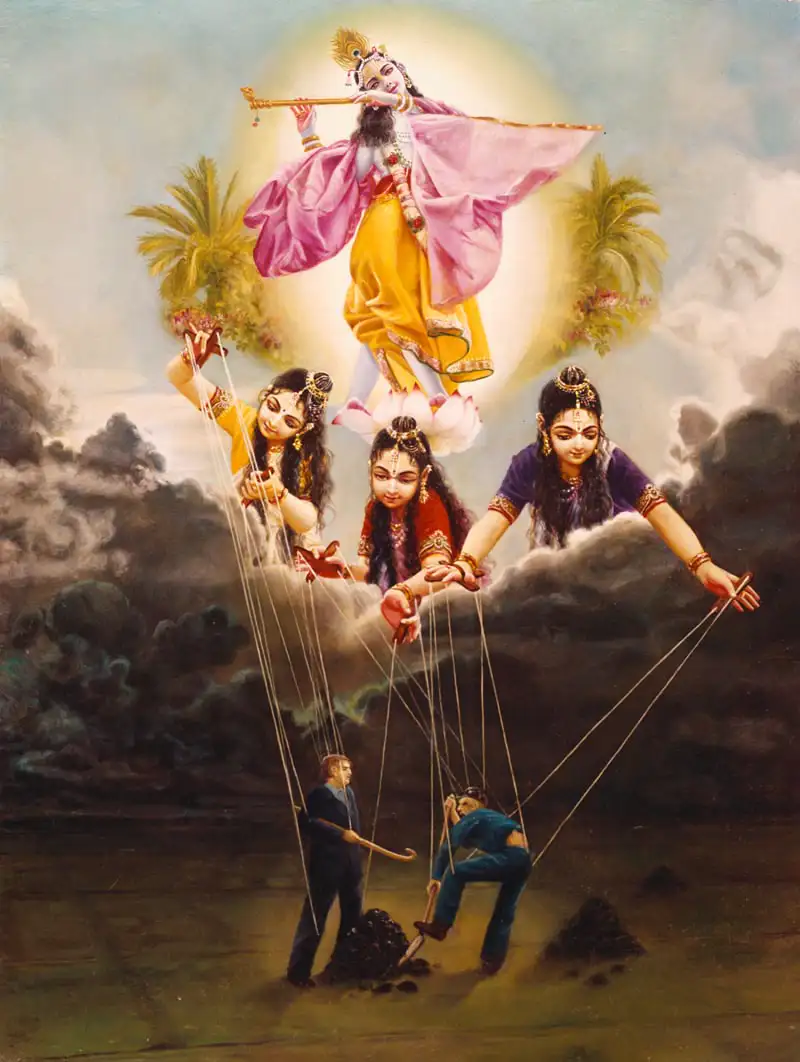
"Material nature consists of three modes – goodness, passion and ignorance. When the eternal living entity comes in contact with nature, O mighty-armed Arjuna, he becomes conditioned by these modes."
— Bhagavad-gītā 14.5
Meanings of the word "guṇa"
- Qualities or material attributes
- Rope – just as a rope woven from threads is very strong, so too material nature, woven from three gunas, is insurmountable for the living entity
- Nirguṇa means "without material qualities"
The Three Guṇas and Their Influence
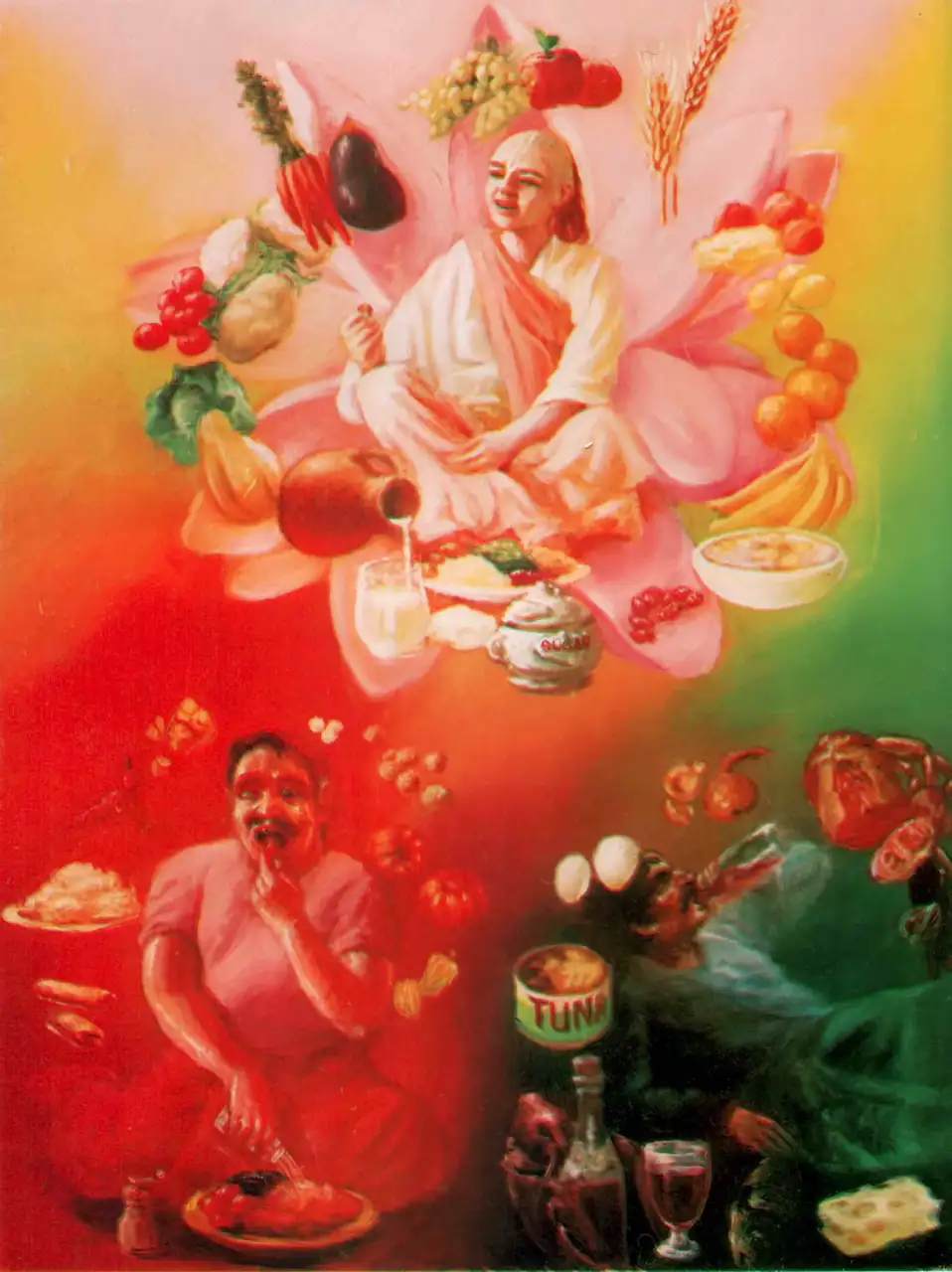
Sattva – Goodness
Conditions a person with a sense of happiness and knowledge.
Represents jñāna śakti – the energy of knowledge.
Rajas – Passion
Conditions with activity, it is born of unlimited desires and longings.
Represents kriyā śakti – the acting energy.
Tamas – Ignorance
Conditions with madness, laziness and sleep.
Represents dravya śakti – the material basis of elements.
Important to Understand
Guṇas, like material nature itself, were created by Krishna. Being the creator of material energy Himself, He is not subject to the guṇas, just as a king or legislator is not subject to those laws. Since the Lord is not subject to the gunas, He is called nirguṇa.
Mode of Goodness – Path to Transcendence
pārthivād dāruṇo dhūmas
tasmād agnis trayīmayaḥ
tamasas tu rajas tasmāt
sattvaṁ yad brahma-darśanam
"Firewood is a transformation of earth, but smoke is better than the raw wood. And fire is even better, for by fire we can derive the benefits of superior knowledge [through Vedic sacrifices]. Similarly, passion is better than ignorance, but goodness is best because by goodness one can come to realize the Absolute Truth."
— Śrīmad Bhāgavatam 1.2.24
Although with the help of the mode of goodness we will not know Krishna, society should nevertheless cultivate the mode of goodness. In the mode of goodness, a person sees things as they are. Having attained the mode of goodness, by practicing Krishna Consciousness a person rises above the influence of the modes and attains pure goodness – śuddha sattva.
How to Overcome the Guṇas?
māṁ ca yo 'vyabhicāreṇa
bhakti-yogena sevate
sa guṇān samatītyaitān
brahma-bhūyāya kalpate
"One who engages in full devotional service, unfailing in all circumstances, at once transcends the modes of material nature and thus comes to the level of Brahman."
— Bhagavad-gītā 14.26
Transcendental Goodness
By cultivating material goodness one can defeat the modes of passion and ignorance, and by cultivating transcendental goodness one can become liberated even from material goodness. To develop transcendental goodness it is inevitable to associate with transcendentalists, or saintly persons.
Influence of the Guṇas
Main Characteristics
Ignorance
Foolishness, madness, illusion, inertia, sleepiness, laziness.
Passion
Unlimited, uncontrollable desires and longings, intense effort, attachment to fruitive activity.
Goodness
Relative purity, illumination, happiness, freedom from sinful reactions.
Qualities of the Mode of Goodness (SB 11.25)
Śamaḥ
Mind control
Damaḥ
Sense control
Titikṣā
Tolerance
Tapaḥ
Duty / Austerity
Satyam
Truthfulness
Dayā
Mercy
Tuṣṭiḥ
Satisfaction
Tyāga
Generosity
Śraddhā
Faith
Comparison of Guṇas
| Aspect | Sattva (Goodness) | Rajas (Passion) | Tamas (Ignorance) |
|---|---|---|---|
| Food | Juicy, healthy, tasty. Milk, grains, fruits. | Too spicy, salty, sour, bitter. | Tasteless, stale, putrid. Meat, alcohol. |
| Happiness | Like poison in the beginning, later nectar. | Nectar in the beginning, later poison. | From beginning to end illusion. |
| Time of Day | Early morning | Day | Night |
| Color | White / Yellow | Red | Black / Blue |
| Animal | Cow | Lion | Monkey |
| Place | Forest | City, village | Brothels, slaughterhouses |
| Destination after death | Heavenly planets, noble family | Born as humans | Hellish worlds, animals |
| Social position | Brahmins (head) | Kṣatriyas, vaiśyas (arms, belly) | Śūdras (legs) |
Austerity, Renunciation and Sacrifice
| Aspect | Sattva | Rajas | Tamas |
|---|---|---|---|
| Austerity | With faith, without desire for material gain | Out of pride, for the sake of fame | Foolishly, torturing oneself or others |
| Renunciation | Renouncing attachment to fruits | Out of fear or troublesome nature | Due to illusion |
| Sacrifice | As duty, according to scriptures | With pride, for benefit | Without faith, contrary to instructions |
| Charity | Out of duty, to a worthy person | Expecting reward, unwillingly | Carelessly, to an unworthy person |
Devotional Service in Three Guṇas
Pure devotional service is above the modes, but until the level of pure service is attained, one must learn to serve Krishna with the body and mind that we have.
Sattva bhakti
Worships seeking to destroy sins, satisfy the Lord or perform one's duties. Performed with knowledge.
Rajas bhakti
Worships desiring sense gratification, fame or wealth. A separatist, considers himself the best. Performed due to material emotions.
Tamas bhakti
Worships desiring violence, out of obstinacy or envy. Envious, proud, angry. Performed blindly.
Pure Devotional Service
The manifestation of unadulterated devotional service is exhibited when one's mind is at once attracted to hearing the transcendental name and qualities of the Supreme Personality of Godhead. As the Ganges flows to the sea without hindrance, so my devotional service is continually flowing toward the Supreme Lord.
— Śrīmad Bhāgavatam 3.29.11-12
QUESTIONS
- Tell about the three gunas, their relationship, and how they affect living entities.
- Mention qualities of a person in each of the gunas.
- What is special about the mode of goodness?
- Can you analyze your day today from the perspective of the influence of the gunas? How would you have acted if you were under the influence of the mode of goodness?