Tolerance and mercy are described in the Bhagavad-gita and Srimad Bhagavatam as some of the best qualities of a devotee. A Vaishnava, a devotee of Lord Krishna, naturally develops 26 qualities within himself, but mercy and tolerance are those qualities that we must cultivate even before becoming perfect Vaishnavas.
Sources: BG 2.14 and SB 3.25.21, The Nectar of Instruction Text 3.
Tolerance
Tolerance has two sides:
Adhibhautika klesha
Miseries experienced due to the body.
Adhidaivika klesha
Miseries experienced due to higher powers, natural disasters, etc.
Adhyatmika klesha
Miseries experienced due to relationships with other living entities and mental suffering.
mātrā-sparśās tu kaunteya
śītoṣṇa-sukha-duḥkha-dāḥ
āgamāpāyino ’nityās
tāṁs titikṣasva bhārata
"O son of Kuntī, the nonpermanent appearance of happiness and distress, and their disappearance in due course, are like the appearance and disappearance of winter and summer seasons. They arise from sense perception, O scion of Bharata, and one must learn to tolerate them without being disturbed." (Bhagavad-gita 2.14)
One needs to learn tolerance in order to properly perform one's duties. Sometimes we have to face unpleasantness or inconvenience. For example, getting up early in the morning or bathing with cold (cool) water might seem unpleasant to the body, but practice shows that those who force themselves to do this are healthier and more effective. The Vedas teach that duties must be performed even under unfavorable conditions.
The scriptures give examples of personalities who valued their duties higher than personal interests. This is the example of Maharaja Shibi from Srimad Bhagavatam, as well as Prahlada Maharaja, Lord Nityananda Prabhu, and Haridasa Thakura.
A sadhu, a sage, and indeed anyone practicing the spiritual path, often has to face obstacles, criticism, and people's contempt. However, this should never be a reason to abandon one's spiritual practice. When we see that people are insulting us, we must understand that these people are controlled by ignorance, so we should feel compassion for them, not hatred.
In Srimad Bhagavatam 4.19.34, Lord Brahma says to Maharaja Prithu: “Please hear my words with great respect. We should always remember that if something happens by the will of providence, we should not regret it too much. The more we try to rectify such unpleasantness, the more we enter into the darkest regions of materialistic thought.”
Šrimad Bhagavatam 3.25.21:
titikṣavaḥ kāruṇikāḥ suhṛdaḥ sarva-bhūtānām
ajāta-śatravaḥ śāntāḥ sādhavaḥ sādhu-bhūṣaṇāḥ
"The symptoms of a sadhu are that he is tolerant, merciful and friendly to all living entities. He has no enemies and is peaceful. He abides by the scriptures, and all his characteristics are sublime."
Indeed, only a Vaishnava can be such a person, because he has no other desires except the desire to serve Krishna. He understands that he will serve Krishna best if he brings as many people as possible to Him. Therefore, his only concern is how to spread Krishna Consciousness, how to help people realize God. He never thinks about how to be liberated himself. He thinks about how to liberate others, this is mercy.
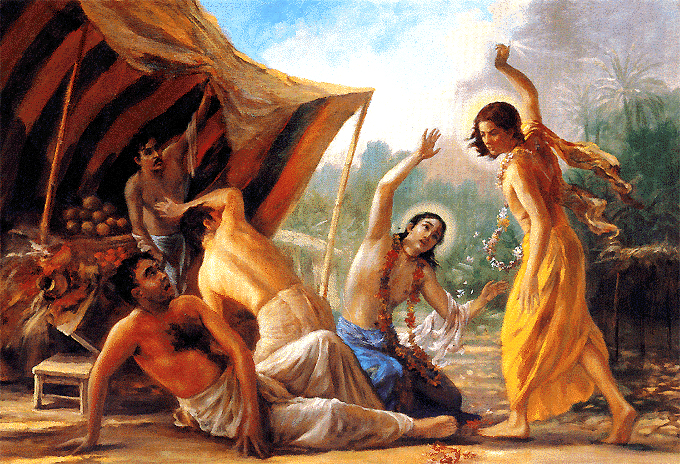
Sometimes devotees have to face even violence. Jesus Christ was crucified. Haridasa Thakura was beaten in 22 marketplaces, Lord Chaitanya's personal associate Nityananda Prabhu was beaten by the debauchees Jagai and Madhai. And yet they patiently carried out their mission – to deliver all fallen souls.
Mercy
"Vaishnava para dukha dukhi"
A Vaishnava feels pain when others are in pain.
The ability to feel the feelings of other beings is called empathy. Empathy is very important for those practicing yoga, but Krishna says that the highest yogi is the one who has developed spiritual empathy - compassion and friendliness towards all living entities, understanding well that behind different forms lies one - spiritual nature, which suffers without Krishna and is happy - being with Him.
In BG 6.32 Krishna says to Arjuna:
"He is a perfect yogī who, by comparison to his own self, sees the true equality of all beings, in both their happiness and their distress, O Arjuna!"
A merciful person is one who wishes well for all living entities. That is, he has no ego and does not seek benefit for himself. He desires good not only for human society but also for all animals.
What is true mercy?
Mercy means giving souls knowledge about the self. True mercy is not feeding a person or clothing him, as most religious people think. Mercy means helping a person to finally get liberated from suffering.
Material existence
Material existence itself, whatever it may be, is an unnatural environment for the soul, so the soul truly suffers even when enjoying material objects, because it does not experience true pleasure.
Mercy and Tolerance
Mercy and tolerance are very closely related. Mercy gives birth to patience and endurance. To be merciful, one often has to give up bodily or mental comfort.
SB 8.7.39
"People in general, being bewildered by the illusory energy of the Supreme Personality of Godhead, are always engaged in animosity toward one another. But devotees, even at the risk of their own temporary lives, try to save them."
SB 8.7.44
"Great personalities almost always accept voluntary suffering because of the suffering of people in general. This is considered the highest method of worshiping the Supreme Personality of Godhead, who is present in everyone’s heart."
In this way, one who cares for the spiritual welfare of all people, sacrificing his own, is most dear to the Lord and quickly wins His recognition. Lord Shiva drank an ocean of poison, seeing that the whole world was in danger.
Prayer of Prahlada Maharaja (SB 7.9.44)
“My dear Lord Nṛsiṁhadeva, I see that there are many saintly persons indeed, but they are interested only in their own liberation... As for me, I do not wish to be liberated alone, leaving aside all these poor fools and rascals. I know that without Krishna consciousness, without taking shelter of Your lotus feet, one cannot be happy. Therefore I wish to bring them back to shelter at Your lotus feet.“
Bhajan about mercy:
yaha jada jiva anadi kala te
nipata kapata agara
jina vishayana anubhavata dusaha dukha
neku viraga na dhara
puni jina vishayana nahim kacchu anubhava
kimi samujhiya sansara
mithyo na jaga yadyapi hari harijana
pragate aganita bara
dosha kripalu subhayana ko jo
kara nita para-upakara
(From Kripalu Maharaja's "Prema Rasa Mandira")
The saints know this very well, but due to their causeless mercy and doing good to others, they continue to come to this world and leave no stone unturned in search of the lost servants of Sri Krishna.
Limits of Tolerance
Chaitanya Mahāprabhu says in Sri Sikshastaka: “taror iva sahiṣṇunā” – one should be more tolerant than a tree. Not expecting any respect for oneself and showing respect to others. A tree does not resist when cut, and often gives shelter to the woodcutter from the sun and rain.
Buddha's Lesson
„O friend! Answer my question. If you give a gift to someone, and he does not accept it, to whom does the gift belong?” The man replied: “Obviously, to the one who gave it.” Lord Buddha smiled and said: “You poured insults on me, but I did not accept them. So, with whom do those insults remain now? And who will suffer damage from them?”
When NOT to tolerate:
- When Krishna, the spiritual master, devotees, ISKCON, or Prabhupāda are insulted.
- Listening to this is not tolerance. One who insults saintly personalities commits a sin.
- A Vaishnava must immediately stop any insults or leave.
Tolerance to Devotees
Nectar of Instruction, Verse 6
“A devotee in his conditioned state should not be seen from a materialistic point of view... Similarly, a self-realized Vaishnava is always on the transcendental platform and should not be criticized for material defects.”
We should by no means criticize other Vaishnavas for their defects. Instead, we should realize that they also want to serve Krishna but do not know how to do it correctly. Therefore they should not be criticized, they should be instructed.
Tolerance to Materialists
One does not need to be a perfect sage to start feeling mercy for other living entities. People are often struck by natural or personal disasters, and sometimes devotees say that this is their karma and they get what they deserve. Although this is undoubtedly true, a Vaishnava should never speak these words with contempt.
An example of behavior is always better than long and preachy speeches. By criticizing materialists and not tolerating their defects, we mostly show our own inability to reach a higher level of Krishna consciousness.
Self-Check Questions
- Briefly explain what patience, tolerance, and mercy are, and how they manifested in the lives of the great acharyas?
- Explain when tolerance is appropriate and when it is not?
- Explain the difference between true mercy and false mercy?
- Quote from memory Bhagavad-gita 2.14 verse and translation.