Definitions
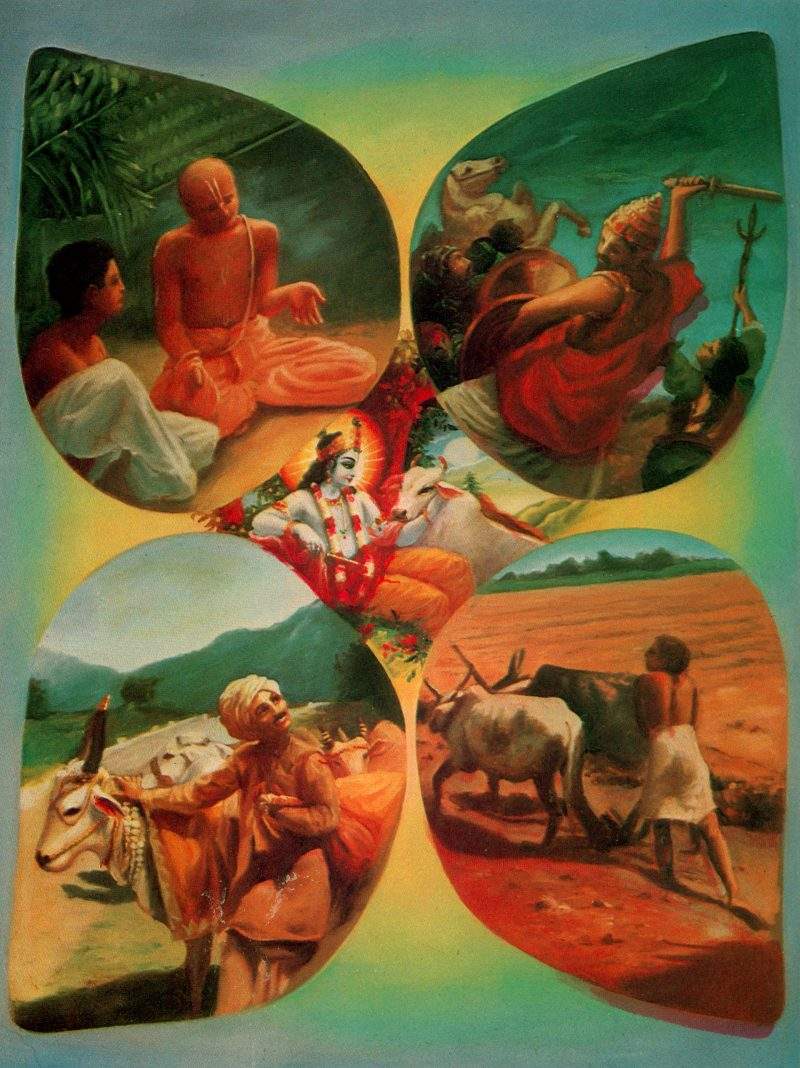
The Word dharma is defined by Monier-Williams' dictionary as follows:
- That which is established or stands firm, a statute, decree, law;
- usage, practice, following custom or rules of conduct, duty;
- justice, righteousness (often as a synonym for punishment);
- virtue; morality, religion, religious merit, good works, that which accords with rules and law, that which accords with nature;
- personification of justice (Indra or Yamaraja), Vishnu, Prajapati, bull, dove;
- nature, character, peculiar condition or essential quality, property, mark, specificity (svabhava);
- sacrifice;
- association with the virtuous;
- religious abstraction, devotion.
From these qualities, Srila Prabhupāda highlights several meanings: religion, duty, and the inseparable quality or function of an object.
The word varna is defined by Monier-Williams' dictionary as follows:
- a mantle, covering;
- a lid or cover;
- outward appearance, exterior, form, figure, shape, color;
- color of the face, especially a good color, brightness, beauty;
- color, dye, pigment (for painting or writing);
- color: race, species, character, nature, quality, property (applicable to both humans and things);
- class of men, tribe, estate, caste: brahmanas, kshatriyas, vaishyas, shudras;
- letter, sound, vowel, syllable, word;
- musical sound or note;
- composition of a poem or song;
- praise, recognition, immeasurable greatness or quantity;
- gold;
- religious rite;
- one who is able to protect oneself.
Prabhupāda highlights these meanings: color and social class, nowadays called caste.
The word ashrama is defined by Monier-Williams' dictionary as follows:
- abode of a hermit, abode of ascetics, cell of a hermit or saint;
- Life stages for brahmanas: Brahmacharin – student of the Vedas, Grihastha – householder, Vanaprastha – hermit, Sanyasin – one who has cast off all worldly concerns, sometimes called bhikshu – religious beggar;
- tent erected on festive occasions;
- college or school;
- forest thicket.
Prabhupāda highlights these meanings: the home of a spiritual teacher where students study the Vedas, a place where people practicing spiritual life reside, and a stage of spiritual life.
Varnasrama dharma can be described as the inseparable function (dharma) of human beings within the social organism or society (varna) and throughout the course of life (ashrama). Every person has duties toward society and toward themselves.
Nitya Dharma and Naimittika Dharma
In the book "Jaiva Dharma" – "The Religion of Living Beings", Bhaktivinoda Thakura speaks about the fact that every object (vastu) which has existence also has its own existential function, which is called dharma. The dharma of sugar is to be sweet, the dharma of water is to be wet. The innate existential function is called nitya dharma – the constant or eternal function. When a real object enters an environment foreign to it, its existential function changes and takes on a different form. For example, overheated sugar becomes bitter; frozen water loses the property of wetness. This altered function of the object is called naimittika dharma – a temporary function.
The Soul (Vastu)
The soul is a vastu – a real existing object. Its nitya dharma is love for God. This function manifests in service to God.
The Conditioned State
When a living being comes under the influence of matter, its eternal function is changed into naimittika dharma – temporary functions (socialism, atheism, various theologies, etc.).
Since the soul is eternal, its nature is also eternal. This means that by removing the situations that create temporary functions, its eternal function – nitya dharma or sanatana dharma – is naturally restored.
For Whom is Dharma Suitable?
The Vedas divide all living beings into two categories: uncivilized living beings and civilized living beings. Uncivilized beings are those who know nothing about their dharma. These include animals and people who live only for pleasures and do not strive for self-realization. The Vedas say:
āhāra-nidrā-bhaya-maithunaṁ ca
sāmānyam etat paśubhir narāṇām
dharmo hi teṣām adhiko viśeṣo
dharmeṇa hīnāḥ paśubhiḥ samānāḥ
"Eating, sleeping, mating, and defending – these four principles are common to both humans and animals. The difference between human life and animal life is that a human can search for God, while animals cannot. Therefore, a human who feels no need to search for God does not differ at all from an animal."
This definition of an uncivilized person differs somewhat from the definition of a civilized person in Western culture, where civilization is perceived as technological progress. Civilized living beings are those who perform dharma, i.e., perform their religious duties to society and themselves. These are humans and various higher beings, such as demigods.
Materialists
They practice religion, worship God, and acknowledge the immortality of the soul, but they seek to remain in this world, wanting to be born in a better position or on heavenly planets. They strive for sensory pleasures.
Transcendentalists
They seek liberation from this existence. They are divided into three groups:
- Jnanis: seeking to realize the Absolute through intellectual efforts.
- Yogis: practicing asanas and meditation to realize the Supersoul.
- Bhaktas: striving to know the Absolute as a Person and to serve Him with love.
Undoubtedly, Varnasrama dharma is intended for civilized living beings or those striving to become such. The Vedas state that a Vaishnava – a person devoted to Krishna – is higher than a Brahmana – the highest social class. This means that a Vaishnava automatically performs the duties assigned to a Brahmana and even more.
Varnasrama belongs to naimittika dharma – that is, the temporary functions of the soul. But as long as the nature of the soul is altered due to the influence of material energy, it must perform these functions.
Adharma – Five Branches of Irreligion
In the material world, dharma can and does have its reflections, which are called adharma. If the word dharma can be interpreted as religion, then adharma undoubtedly means that which resembles religion but is not.
Srimad Bhagavatam 7.15.12 warns of five forms of adharma (irreligion):
Vidharma
Atheism. The denial of God, the movement of free-thinkers, Mayavada philosophy.
Para-dharma
Altered religion. Man-made principles claiming that the religion given by God is outdated (e.g., the Baha'i faith).
Upa-dharma
Pretentious religion. Creating new religions by imitating Vedic principles (e.g., Osho, Sathya Sai Baba).
Chala-dharma
Deceptive religion. Manipulating words and truths (e.g., certain interpretations of Buddhism).
Ābhāsa-dharma
Pretense. When a person is unable to fulfill the duties of one's estate but demands respect.
One example of adharma is modern Hinduism, which is full of all five manifestations of adharma.
Varnasrama Dharma – A Perfect Social Order
The word varnasrama means a system of social and spiritual distribution. Every person is governed by a certain guna, which determines how valuable they are to society. Krishna says in BG 4.13:
cātur-varṇyaṁ mayā sṛṣṭaṁ
guṇa-karma-vibhāgaśaḥ
tasya kartāram api māṁ
viddhy akartāram avyayam
"According to the three modes of material nature and the work associated with them, the four divisions of human society are created by Me. And although I am the creator of this system, you should know that I am yet the nondoer, being unchangeable."
Purpose
Two types of varnasrama dharma are distinguished: one seeking material goals (dharma, artha, kama, moksha) and one seeking to satisfy Krishna (daivi varnasrama). Essentially, it is a system of cooperation where everyone serves Krishna according to their abilities. Our primary duty is our duty to God.
SB 1.2.13 states:
ataḥ pumbhir dvija-śreṣṭhā
varṇāśrama-vibhāgaśaḥ
svanuṣṭhitasya dharmasya
saṁsiddhir hari-toṣaṇam
"O best among the twice-born, it is therefore concluded that the highest perfection one can achieve by discharging his duty according to caste and ashrama is to please the Personality of Godhead."
The Caste System
When speaking of a caste society, the unattractive issue of privilege immediately arises. Hinduism is usually associated with a caste system where brahmanas and kshatriyas are privileged estates exploiting others. Of course, brahmanas stand at the top, enjoying power and people's obedience. Indeed, that is what happened. In the 12th Canto of Srimad Bhagavatam, it is said that in Kali-yuga demons will be born as brahmanas. Such brahmanas demand rights and respect for themselves but do not want to perform the duties assigned to the brahminical estate.
Duties and Varnas
Duties of All Humans
SB 7.11.8-12 lists 30 qualities that should be acquired upon being born as a human:
Truthfulness, mercy, austerity, cleanliness, tolerance, control of the mind and senses, non-violence, celibacy, charity, study of scripture, simplicity, satisfaction, service to saintly persons... and full surrender to the Lord.
The Twice-Born (Dvija)
Those for whom the garbhadhana ceremony and other purifying rituals have been performed are called dvija. They must follow the principles of the four ashramas.
Note: Those who are born into brahmana families but do not follow the requirements set by the Vedas are only dvija-bandhu (friends of the twice-born).
Brahmanas
Qualities (BG 18.42): Peacefulness, self-control, austerity, purity, tolerance, honesty, knowledge, wisdom, and religiousness.
6 Duties (Shad-dharma): To study and to teach others, to perform sacrifices and to teach others to perform them, to accept and to give charity.
A brahmana cannot accept a salary or serve lower varnas (shva-vritti), but may accept charity.
Kshatriyas
Qualities (BG 18.43): Heroism, power, determination, resourcefulness, courage in battle, generosity, leadership.
Duties: To protect citizens, to lead. May collect taxes.
A kshatriya cannot accept charity but can perform the other 5 brahminical duties.
Vaishyas
Qualities (BG 18.44): Agriculture, cow protection, trade.
Goal: To earn wealth using their abilities, to nourish society.
Vaishyas should always follow the instructions of the brahmanas.
Shudras
Qualities (SB 7.11.24): Obedience to higher classes, service to the master, non-stealing, truthfulness.
Status: Shudras are fully maintained. This is not a system of exploitation, but one of cooperation.
Ashramas – Four Stages of Spiritual Life
Prabhupāda said that first one must create varnas, and then ashramas, or divisions of spiritual life. Since people belong to various gunas, the spiritual practice they engage in is also different. According to the Vedic system, brahmanas had to pass through four stages of life: brahmacharya, grihastha, vanaprastha, and sannyasa. Kshatriyas were assigned the first three stages (sannyasa is not recommended for them). Vaishyas should not accept vanaprastha – they can live religiously at home until the end of their lives. For shudras, only one ashrama applied. They had no need to study in a gurukula – everything a shudra needs, he can learn in the family or by serving.
The higher estates were required to send their children to schools where they lived as brahmacharis (students who observed celibacy). At the age of 20-25, they could marry, and at the age of 40-50 – leave the family and go to the forest (vanaprastha). In the final stage, a person would accept sannyasa – a status of renounced life. A true sannyasi would not stay in the homes of grihasthas longer than it takes to milk a cow (so as not to become attached).
Of all four layers of spiritual life, only grihasthas were allowed limited sensory satisfaction. However, this also meant that the grihastha supports the family and all other layers: brahmacharis, vanaprasthas, as well as sannyasis.
At the junctions of day and night, specifically having risen early in the morning and in the evening, a person must fully immerse themselves in reflections about the spiritual master, fire, the sun god, and Lord Vishnu.
Brahmachari
Student Life
Lives in the ashram of the spiritual master, observes celibacy, studies the Vedas, collects alms for the teacher, learns service and humility. Eats only after receiving permission.
Grihastha
Family Life
Duty – to earn money and honestly support the brahmacharis, vanaprasthas, and sannyasis. Sexual relations are allowed only for the procreation of children at favorable times.
Vanaprastha
Retirement/Detachment
Withdrawal from family duties. Strict diet (fruits, unprocessed grains), austerity (enduring weather conditions), no concern for bodily beauty (no cutting or combing hair). The goal – to detach from the body.
Sannyasi
Full Renunciation
"One who has cast off". A traveling ascetic, a natural teacher of society. Has no material attachments, considers a woman as deceased (a widow). Takes vows of eternal monkhood.
Varnasrama Dharma and ISKCON
Srila Prabhupāda said that ISKCON is a brahminical movement and its goal is to create a brahmana class in society. Only then can all other layers function properly. The Rig Veda compares the brahmanas to the head of the universal form (virat-purusha) – they coordinate the work of all body parts.
Sri Chaitanya Mahāprabhu rejected the varnasrama system as a direct means of reaching Krishna, but did not deny the necessity of the system itself for social organization. The most important thing is to approach a spiritual master and learn bhakti yoga. Many of Chaitanya's associates were family people (Pundarika Vidyanidhi, Sivananda Sena, etc.), not just sannyasis.
In today's society, roles are intertwined (mixed varna). In ISKCON, we strive to restore this culture, but it is a long process. Most members start from the position of a shudra (service), but through sadhana-bhakti, study of scriptures, and the holy name, they can rise to become brahmanas (vipra – the learned).
"Prabhupāda said that we will create the brahmana class by chanting the holy name. (...) If a person develops a taste for a higher kind of activity and can perform that activity steadily, he can be considered a brahmana."
Self-Check Questions
- List the four varnas in Sanskrit order and describe them.
- List and describe the four ashramas.
- Explain the difference between the caste system and varnasrama dharma.
- Quote the verse from Bhagavad Gita 4.13.
- Must everyone become a sannyasi? Why?
- Is it possible, in your view, to implement the Varnasrama system in modern society?